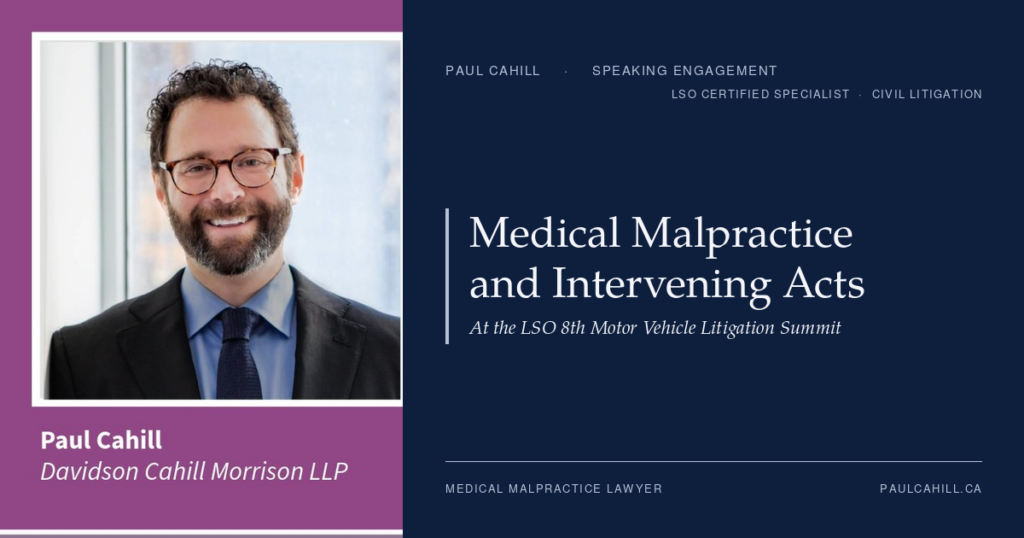
On September 16, 2025, Paul presented “Causation: Medical Malpractice and Intervening Acts” at the Law Society of Ontario’s 8th Motor Vehicle Litigation Summit. The two-day program was held at the LSO’s Donald Lamont Learning Centre at 130 Queen Street West in Toronto, with co-chairs Susan Gunter of Dutton Brock LLP and Adam Wagman, C.S., of Howie, Sacks & Henry LLP. Paul’s segment ran from 11:20 to 11:40 a.m. on Day 1 and addressed a problem that motor vehicle litigators encounter more often than they expect: when an MVA case becomes, or includes, a medical malpractice case.
The framing of the presentation followed a recent Ontario decision that demonstrates how the intersection of MVA and medical malpractice plays out at trial.
When motor vehicle cases become medical malpractice cases
Motor vehicle accidents routinely send people to physicians, hospitals, and other health professionals for a broad range of medical services. For simple and uncomplicated injuries, there is little opportunity for medical malpractice to intervene. For seriously injured accident victims who require significant medical care, including surgeries and extended hospital stays, there is an increased risk of compounding medical error along the way.
When that error occurs, the case looks different in important ways from a conventional MVA file. The defendants are different. The standard of care is different. The expert evidence is different. The collateral benefits analysis is different. And the practical question for plaintiff counsel, of whether to pursue the medical malpractice piece at all, is one that has to be worked through carefully on the facts of each file.
Baines v Abounaja: the facts
Baines v Abounaja, 2023 ONSC 2078, is a trial decision of the Ontario Superior Court of Justice that turns on this intersection. The plaintiff was involved in a single-vehicle motorcycle accident on June 23, 2011, at approximately 10:45 p.m. He lost control of his motorcycle and struck a metal sign post with his left leg, fracturing his femur. He was taken to Ajax Hospital, a community hospital without a vascular surgery service.
The plaintiff was discovered to have absent pedal pulses at approximately 11:40 p.m. The defendant emergency room physician was aware of that. What followed was a series of calls to CritiCall (a referral service that arranges patient transfers between hospitals and specialists) over the next several hours. At trial, the court found that the defendant physician did not initially tell the trauma surgeon about the pulseless limb when he first contacted CritiCall at 12:04 a.m. Subsequent calls at 2:34 a.m., 2:50 a.m., 3:02 a.m., and 3:45 a.m. each involved further consultations, further delays, and no transfer.
The plaintiff was eventually accepted for transfer at 4:49 a.m. and arrived at St. Michael’s Hospital at 6:15 a.m. By then, 6 hours and 35 minutes of ischemia time had elapsed since the pulseless leg was identified. Surgery began at 9:15 a.m., 9 hours and 35 minutes after the pulseless leg was identified. The plaintiff’s left leg was amputated.
Standard of care
The standard of care issue at trial was whether the defendant physician had communicated the pulseless leg to CritiCall, whether the urgency had been conveyed, and whether the physician had insisted on transfer in the face of the delays that followed. The trial judge found that Dr. Abounaja’s failure to insist on an urgent transfer leading to escalation fell below the standard of care.
That framing is worth noting. The standard of care was not framed as a failure to perform a surgery the physician could not perform, or to consult a specialty the hospital did not have. It was framed as a failure to perform the part of the work that an emergency room physician at a community hospital can do, which is to insist, escalate, and remain on the call until the transfer happens. The treatable surgical problem was at St. Michael’s. Getting the patient there was the work the defendant could and should have done.
Causation
The causation analysis applied the “but for” test. The trial judge found that, but for the delays, the plaintiff would likely have had surgery to revascularize his limb. On the evidence of the vascular surgery experts at trial, the court was satisfied that, but for the delays, the plaintiff’s left leg would not have been amputated. The window for revascularization had closed during the hours of delay, and the closure was traceable to the failures in communication and escalation at Ajax Hospital.
The hospital
The plaintiff also pleaded negligence against the hospital. The trial judge found that the standard of care of the hospital had been established on the evidence, but declined to apportion any liability against it. The reason was evidentiary: there was no evidence about who or what events underlay the delay on the hospital side. As the trial judge put it (at paragraph 377), there was insufficient evidence on which a finding of breach could be made against Ajax Hospital, and no apportionment could be made.
The point for plaintiff counsel is one about pleading and investigation. Where the breach is the failure to escalate, and where multiple actors are involved in the escalation chain, the evidentiary picture matters. The plaintiff’s case against the physician was airtight; the case against the hospital was not built out on the evidence at trial.
Collateral benefits
A second issue at trial concerned the deductibility of the Statutory Accident Benefits the plaintiff had received under his private automobile insurance policy. The defendant physician argued that those benefits, paid under the Statutory Accident Benefits Schedule through the Insurance Act, should be deducted from any award against him.
The trial judge rejected the argument. The reasoning, at paragraphs 383-385, is doctrinally significant. The action was not based on the negligence of the owner or operator of a motor vehicle. It was based on the professional negligence of the defendant physician. Damages occasioned by the physician’s negligence were not properly characterized as arising from the use or operation of an automobile. Section 267.8 of the Insurance Act, which addresses collateral benefits deductibility in motor vehicle accident claims, applies only to those claims. The trial judge applied the reasoning of the Supreme Court of Canada in Cunningham v Wheeler, [1994] 1 SCR 359, on the general rule of non-deductibility of collateral benefits outside the motor vehicle accident context, and held that the SABs payments were not deductible.
The practical implication for plaintiff counsel is significant. Where the medical malpractice claim is brought separately from, or in addition to, the underlying MVA tort claim, SABs payments do not reduce the medical malpractice award. The plaintiff in Baines recovered for the amputation on the medical malpractice claim without offset against the accident benefits he had received as a motor vehicle accident victim.
When to consider an intervening medical malpractice claim
The practice management framework Paul outlined at the Summit identifies three scenarios in which MVA counsel should turn their mind to a potential intervening medical malpractice claim.
The first is the absence of any viable non-medical tortfeasor. Baines is the example. The plaintiff was on a single-vehicle motorcycle accident for which he was responsible. There was no other motorist to sue. Without the medical malpractice claim, his only compensation for the amputation would have been the SABs payments. For seriously injured at-fault accident victims who appear to have suffered an even worse outcome following medical treatment, the possibility of medical malpractice deserves consideration whenever the damages are objectively significant.
The second is a viable but underinsured non-medical tortfeasor. Where the client has a tort claim against another motorist, but the policy limits will not cover the damages because the injuries are catastrophic or because multiple claimants are competing for the same limits, the medical malpractice route is worth exploring if it is factually supportable.
The third is an obvious intervening medical error. Where the medical record shows a clear error that the defence in the MVA action will almost certainly raise as a novus actus interveniens or by third-partying the physician, the best course is usually to pursue both the MVA and the medical negligence claim contemporaneously rather than to wait for the defence to force the issue.
Practical observations
The interplay between motor vehicle accidents and intervening medical malpractice presents complex problems for counsel on both sides. Baines is a useful illustration because it shows the successful prosecution of an intervening medical malpractice claim where the plaintiff had no other viable option for compensation apart from accident benefits. It also shows the doctrinal architecture: the standard of care framed at the level the physician could actually meet, the “but for” causation analysis built on careful expert evidence, the limits of what plaintiffs can recover against a co-defendant hospital on a thin evidentiary record, and the Cunningham v Wheeler analysis on collateral benefits.
Counsel should always be vigilant that medical malpractice may occur in the medical care that follows a motor vehicle accident. Given the cost and risk of medical malpractice claims, counsel should also carefully consider whether each case is better approached as a poor medical outcome arising as a natural consequence of accident-related injuries, or as a separate intervening act of medical negligence. The three-scenario framework above is the starting point for that analysis. The decision in any given file is one that has to be worked through on the evidence and the economics.