In October 2016, Paul Cahill settled a wrongful death claim on behalf of the family of a 68-year-old man who died unexpectedly in hospital after a routine equipment setup error. The patient had been placed on a continuous positive airway pressure (CPAP) machine that required supplemental oxygen for him to receive an adequate concentration of oxygen with each breath. Hospital staff connected the CPAP mask and started the machine, but did not connect the oxygen tubing to the supplemental oxygen supply. The patient was receiving pressurized room air rather than the oxygen-enriched air he had been prescribed. He soon recognized that something was wrong and called for assistance. The response that came was insufficient to recover his oxygen saturation in time. He went into cardiopulmonary arrest. He did not survive.
Equipment setup errors of this kind are among the most preventable forms of in-hospital death. They occur not because the underlying technology is complex but because the human and institutional safeguards that surround the technology either are not in place or are not followed. Tubing connection errors are a recognized category of adverse event in modern patient safety literature, identified in sentinel event alerts and industry guidance from organizations including the Institute for Safe Medication Practices, the ECRI Institute, the United States Food and Drug Administration, and The Joint Commission. The published case literature includes reports of patients whose oxygen tubing was inadvertently connected to a medical air outlet rather than the oxygen outlet, of bag-valve masks left attached to room air during emergency resuscitation, and, as in this case, of CPAP and ventilator setups that delivered pressurized air without the supplemental oxygen the patient required. The outcomes range from prompt recognition and recovery without injury to death.
The civil claim in this case was advanced against the hospital and the nursing and respiratory staff involved in the equipment setup and in the response to the patient’s call for assistance. The settlement was reached without admission of liability and the terms are confidential. The clinical and legal pattern is one that recurs in hospital negligence litigation, and the safeguards that would have prevented this death are part of the established patient safety infrastructure of any acute-care institution.
The clinical context
Continuous positive airway pressure is a respiratory therapy that delivers pressurized gas through a sealed face mask, holding the upper airway open during inhalation and exhalation. The technology was originally developed for the treatment of obstructive sleep apnea and has since become a routine tool in acute hospital care for patients with various forms of respiratory compromise. In hospital, CPAP is typically used for patients whose oxygenation is failing but whose work of breathing does not yet require full mechanical ventilation. The therapy buys time, recruits collapsed lung tissue, reduces the effort of breathing, and improves the patient’s overall oxygenation.
The pressurized gas delivered by a hospital CPAP machine is, by default, room air. Room air contains approximately 21 percent oxygen. For many patients on CPAP, particularly those with chronic obstructive pulmonary disease, heart failure, pneumonia, or any condition that impairs gas exchange in the lungs, 21 percent oxygen is not enough. The standard prescription for such patients is CPAP plus supplemental oxygen, which is delivered by connecting an oxygen flow line from the wall oxygen outlet to a port on the CPAP machine or the mask. The respiratory therapist or nurse setting up the CPAP titrates the supplemental oxygen flow rate to achieve a target oxygen saturation, typically measured continuously by pulse oximetry.
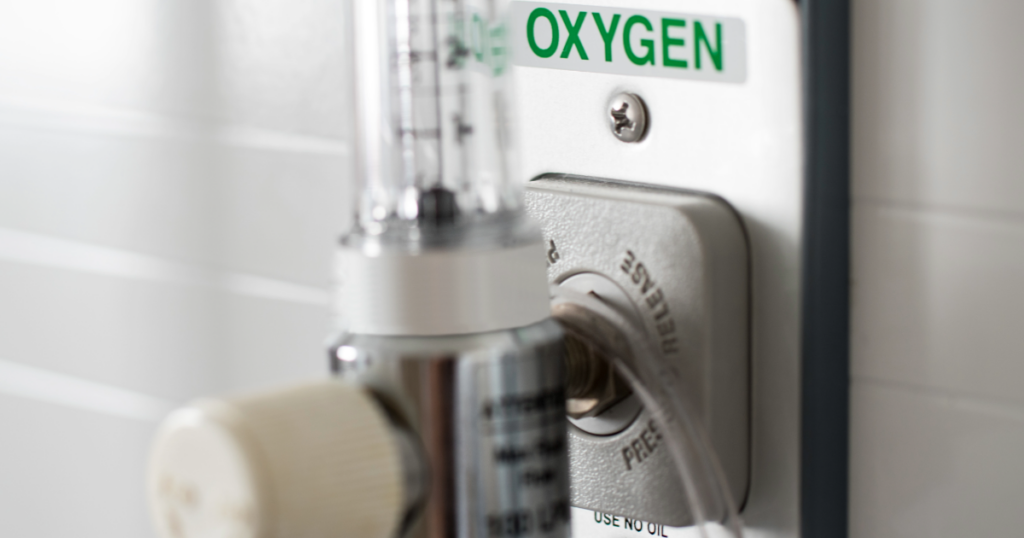
The configuration is straightforward. Wall oxygen outlet, flow meter, tubing, port on the CPAP circuit. Each connection is made by hand and is held in place by a friction fit or a threaded coupling. There is no automated check that the connections have been made. There is no alarm on the CPAP machine itself to indicate that supplemental oxygen is, or is not, flowing into the circuit. The CPAP runs whether or not the oxygen is attached. The mask seals and the pressurized air is delivered. The difference between a CPAP delivering oxygen-enriched air and a CPAP delivering pressurized room air is invisible from the bedside without an oxygen analyzer or, more practically, by inference from the patient’s continuously monitored oxygen saturation.
The clinical consequences of running a CPAP without the supplemental oxygen the patient has been prescribed depend on the underlying severity of the patient’s respiratory disease. For a patient who needs only modest supplementation, the consequences may be slow and recoverable. For a patient whose underlying disease produces a substantial oxygen requirement, the consequences can develop within minutes. The patient becomes progressively hypoxic. The pulse oximetry reading drops. The body’s compensatory mechanisms (increased respiratory rate, increased heart rate) struggle to keep up. The patient experiences shortness of breath, distress, agitation, and the recognition that something is wrong. If the underlying respiratory compromise was severe and the supplemental oxygen demand was substantial, the patient can move from a normal oxygen saturation to a critically low saturation, and from a critically low saturation to cardiopulmonary arrest, in a span of minutes.
What the standard of care expects
The safeguards that are supposed to prevent this category of death operate on two levels.
Equipment setup verification. The first level is at the moment the equipment is connected. The published patient safety guidance from organizations including the Joint Commission, ISMP, and ECRI calls for explicit verification of every connection in a medical gas delivery circuit at the time of setup. The verification is a teach-back step, performed by the staff member setting up the equipment, which traces the circuit from the wall outlet to the patient. The flow meter should be reading the prescribed flow. The tubing should be securely connected at both ends. The CPAP machine should be drawing supplemental oxygen as evidence by the configuration of the components. Where institutional protocols permit, an oxygen analyzer can be used to confirm the inspired oxygen concentration. The verification step takes seconds. Its purpose is to catch precisely the kind of error this case describes.
Continuous monitoring. The second level is the continuous monitoring that should follow. A patient on CPAP with supplemental oxygen, particularly an older patient with respiratory compromise, should be on continuous pulse oximetry. The monitor should have alarm limits set such that a falling oxygen saturation triggers an audible alert at the bedside and at the nursing station. Bedside reassessment should be scheduled at intervals appropriate to the patient’s acuity. If the equipment was set up incorrectly, the patient’s saturation will drop within minutes of being placed on the machine. The alarm should sound. The response should be immediate.
The published literature on patient deterioration and “failure to rescue” identifies the gap between the patient’s clinical deterioration and the institutional response as the central failure mode in this category of harm. The literature on failure to rescue makes the point that almost all critical inpatient events are preceded by warning signs for some interval before the arrest occurs, and that the institutional safeguards (rapid response teams, structured monitoring, defined escalation protocols) are designed to convert that interval into a recovery rather than a death. The standard of care assumes that those safeguards are in place and that they function.
The patient and the failure
The patient was 68 years old. He had been admitted to the hospital and was on a CPAP machine with prescribed supplemental oxygen. The setup of the machine was performed by hospital staff. The oxygen tubing was not connected to the supplemental oxygen supply. The CPAP began delivering pressurized room air. The patient was not receiving the oxygen-enriched air he had been prescribed.
The patient recognized that something was wrong. The exact symptoms he described to staff are not captured in the brief description of the case, but the clinical sequence is reconstructable from the chronology. As his oxygen saturation fell, he would have experienced increasing shortness of breath, a sense of suffocation, agitation, and progressive distress. He called for assistance. He was unable to regain his oxygen saturation. He went into cardiopulmonary arrest. He died.
Two things went wrong, working in combination. The first was the setup itself: the oxygen tubing was not connected, and the failure was not caught at the moment of equipment setup. The second was the response to his deterioration: the patient’s call for help, whether by the call bell or by his audible distress, did not result in the kind of immediate bedside reassessment, recognition of hypoxia, and corrective action that would have restored his oxygenation in time. Each of the two failures, on its own, would have been recoverable. The combination was fatal.
The legal framework
A claim of this kind sits within hospital negligence litigation. The general elements of a civil malpractice claim are explained in our foundational post on suing for medical malpractice in Ontario. Their application in a case of hospital equipment failure and inadequate response to patient distress has a recognizable structure.
Standard of care. The standard of care in this category of case applies on two levels. At the level of the individual practitioner, the standard requires that a respiratory therapist or nurse setting up CPAP with prescribed supplemental oxygen verify, at the time of setup, that the oxygen tubing is connected and that supplemental oxygen is actually flowing into the circuit. At the institutional level, the standard requires that the hospital have policies in place that direct continuous pulse oximetry monitoring of patients on CPAP, alarm limits appropriate to the patient’s clinical status, structured monitoring intervals, and escalation protocols that bring a competent clinician to the bedside within minutes of an alarm or of a patient’s call for help. The standard of care in hospital negligence cases is increasingly informed by published patient safety guidance from organizations such as the Joint Commission, ISMP, and the equivalent Canadian bodies including the Canadian Patient Safety Institute and Healthcare Excellence Canada.
Causation. Causation in a case of unconnected supplemental oxygen leading to hypoxia and cardiopulmonary arrest is among the most direct in medical malpractice litigation. The mechanism is well-understood. The patient had a prescribed oxygen requirement. The supplemental oxygen was not delivered. The patient became progressively hypoxic. Hypoxia at sufficient severity and duration produces cardiopulmonary arrest. The arrest, in a patient whose oxygenation had been deteriorating for minutes before help arrived, was not recoverable. The chain from breach to injury is short. Defence arguments in cases of this kind sometimes focus on the patient’s underlying condition (whether the patient would have survived an event of any kind given his comorbidities), but those arguments are typically met by expert evidence that the patient was clinically stable on appropriately delivered CPAP before the equipment failure and would have remained stable if the equipment had been set up correctly.
Damages. The damages in a wrongful death case of this kind include the deceased’s pain and suffering during the period of hypoxic distress before the arrest, lost income up to the date of death (and dependency losses where applicable), and any out-of-pocket expenses incurred by the family in the period between the event and the death. Surviving family members have separate claims under the Family Law Act for the loss of care, guidance, and companionship and for any pecuniary losses they suffered. For a 68-year-old patient who may or may not have still been working, the dependency-related losses tend to be more modest than for younger decedents, but the Family Law Act claims for loss of guidance and companionship from a spouse, an adult child, or a grandchild remain significant.
Vicarious liability. In hospital negligence cases, the hospital is typically vicariously liable for the acts and omissions of its nursing and respiratory therapy staff, who are usually hospital employees. Where physicians are involved, the analysis is more complex because physicians are typically independent contractors rather than hospital employees in Ontario. In a case where the breach is at the level of equipment setup and response to patient distress, the principal liability sits with the hospital and its staff. The hospital is also directly liable for any institutional failures in policy, protocol, training, or supervision that contributed to the breach.
How the case resolved
The matter settled on confidential terms before trial. The factors that supported a productive resolution included clear expert evidence on the standard of care for CPAP equipment setup and verification, clear expert evidence on the institutional standard for monitoring and response, a direct causal chain from the equipment failure through the hypoxia to the cardiac arrest, and significant Family Law Act damages on behalf of the surviving family. The factual narrative was unfortunately straightforward: the patient should not have died, and the institutional safeguards that should have prevented his death either were not in place or were not followed.
Why this case matters
For patients and families, the lesson of this case is not to fear standard hospital equipment. CPAP and supplemental oxygen are routine and generally safe interventions. The lesson is about what should accompany them. A patient on CPAP with supplemental oxygen should be on continuous oxygen saturation monitoring. The patient and family are entitled to ask: Is the saturation monitor on? Where is the alarm? Who responds when the alarm sounds? How quickly? If the alarm parameters are not set to alert the staff at the saturation thresholds appropriate for the patient’s condition, or if the response time to alarms and to call bells is materially longer than minutes, the safeguards are not functioning.
For hospitals and clinical staff, the lesson is that the safety infrastructure for routine equipment is the standard of care. Verification at setup, continuous monitoring, audible alarms with appropriate limits, defined escalation protocols, structured response to patient calls for assistance. Each of these elements is described in published patient safety guidance and is expected at the institutional level. Their presence is what allows routine equipment to be safe. Their absence is what makes recoverable events fatal.
For the broader practice of hospital negligence litigation in Ontario, this case sits within a category of claims where the institutional breach is more important than any individual practitioner’s act. The questions that drive the analysis in such cases are about systems: what policies were in place at the time of the event, whether those policies were followed, what training and supervision the staff had received, what monitoring was occurring, and how the institution responded when the patient called for help. The defendants in such cases are typically the hospital itself, the individual staff members directly involved, and, where applicable, the manufacturers of any equipment whose design contributed to the error. The expert evidence draws on patient safety literature and on the institutional standards of comparable hospitals in Ontario.
Settlement Date: October 2016
Jurisdiction: Ontario
Counsel for the plaintiff family: Paul J. Cahill