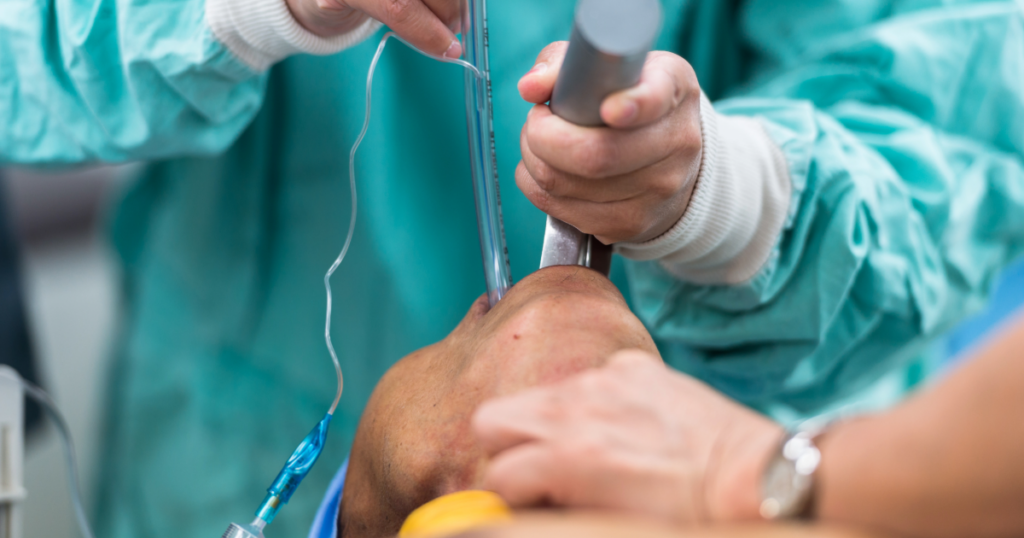
In April 2015, Paul Cahill settled a wrongful death claim on behalf of the family of a 67-year-old man who suffered a hypoxic brain injury during emergency airway management. The patient had come to the emergency department with a history of shortness of breath. He was triaged urgently. As his respiratory distress worsened, an attempt was made to secure his airway with an endotracheal tube. The tube placement was suspicious for an esophageal placement, meaning that the tube had not entered the trachea (the airway leading to the lungs) but had instead been placed in the esophagus (the tube leading to the stomach). An anesthesiologist was paged for assistance. The anesthesiologist arrived after some time. By then, the patient had suffered a hypoxic brain injury severe enough that he never recovered. He died months later.
Two failures, working together, drove the outcome. The first was that the original endotracheal tube placement was not in the trachea. Esophageal intubation is a recognized adverse event in emergency airway management and is one of the leading causes of preventable death and severe brain injury during anesthesia and emergency medicine. The published clinical guidance, both before and after this case, treats prompt recognition and prompt correction as the central safeguards. The second failure was the time that passed between the recognition of the problem and the arrival of the help that was needed to fix it. The combination produced the result.
The civil claim was advanced against the treating physicians and the hospital. The settlement was reached without admission of liability and the terms are confidential. The clinical and legal pattern is one that recurs in airway management litigation, and the safeguards that would have prevented this outcome are not difficult to describe.
The clinical context
Endotracheal intubation is the placement of a hollow tube through the mouth, past the vocal cords, into the trachea, where it is used to deliver oxygen and remove carbon dioxide while the patient cannot breathe adequately on their own. It is one of the most common life-saving procedures performed in emergency departments, intensive care units, and operating rooms. In skilled hands, with a cooperative airway, first-pass success rates exceed 90 percent. In the emergency department, where patients are often physiologically unstable, the airway is often unprepared, and the operator may have limited time to optimize the conditions, the procedure is more difficult and the consequences of failure are more immediate.
The most catastrophic failure mode in emergency intubation is unrecognized esophageal intubation. The esophagus sits immediately behind the trachea. The two structures are separated, at the level of the vocal cords, only by the small cartilaginous landmark of the cricoid. A blind or anatomically obscured pass of the tube can readily enter the esophagus instead of the trachea, particularly in patients with edema, distorted anatomy, or active vomiting. The clinical signature of an esophageal intubation is the absence of carbon dioxide return on exhalation, the absence of bilateral breath sounds on auscultation, and the progressive drop in oxygen saturation as the patient ventilates the stomach instead of the lungs.
The standard of care for confirming tube placement, both at the time of this case and today, requires more than the operator’s visual or tactile sense that the tube went where it was supposed to go. The Canadian Airway Focus Group, in its 2013 guidelines and again in its 2021 update, and the parallel American and European guidelines, identify continuous waveform capnography as the single most reliable confirmation tool. Waveform capnography measures exhaled carbon dioxide breath by breath and produces a characteristic graphical trace when the tube is in the trachea and the patient is being ventilated. A flat trace, an absent trace, or a trace that disappears after the first one or two breaths is highly suggestive of esophageal placement. Auscultation, observation of chest rise, and pulse oximetry are useful supports but are not, on their own, sufficient.
When tube placement is suspect, the published guidance is unambiguous. The recognized failure modes in airway management litigation, identified in the Canadian Airway Focus Group’s review of closed claims and in the United Kingdom’s Fourth National Audit Project (NAP4) of major airway complications, include persistence with one technique when intubation proves difficult, failure to recognize an evolving “cannot ventilate, cannot oxygenate” scenario, and failure to perform timely emergency front-of-neck airway access when indicated. The published response to a suspected esophageal intubation is immediate removal of the tube, resumption of mask ventilation, and either reattempt by a more experienced operator, transition to a supraglottic device, or escalation to a surgical airway. The window in which this can be done without irreversible injury is short. Severe hypoxia for more than four to six minutes produces irreversible brain damage. After ten minutes, brain death is the typical outcome.
The patient and the failed airway
The patient was 67 years old. He arrived at the emergency department with a history of shortness of breath. He was triaged urgently and was promptly assessed by emergency department staff. As his respiratory distress worsened, the clinical situation moved from monitoring and treatment to active airway management. The decision was made to intubate him.
An attempt at endotracheal tube placement was made. The placement was suspicious for esophageal intubation. The clinical signs of esophageal placement, whether they were a flat capnography trace, the absence of bilateral breath sounds, the absence of chest rise, the lack of fogging in the tube, or the failure of the patient’s oxygen saturation to recover after ventilation, were present in some configuration. The response to that suspicion is what shapes the rest of the case.
An anesthesiologist was paged for assistance. The hospital had an in-house anesthesiology service available on call. The anesthesiologist took some time to arrive. During that interval, the patient was not being ventilated adequately. His oxygen saturation continued to drop. By the time effective airway management was achieved, the patient’s brain had been deprived of oxygen for longer than the window during which damage is reversible. He suffered a hypoxic brain injury. He did not recover. He died months later from the consequences of that injury.
The legal framework
A claim of this kind sits in a category of medical malpractice litigation where the breach, the injury, and the causal link between them are well-characterized in the published literature. The doctrinal questions are the standard ones: standard of care, causation, and damages. The application of those questions to airway management produces a recognizable analytical pattern, which is set out below. The general elements of a civil malpractice claim are explained in our foundational post on suing for medical malpractice in Ontario.
Standard of care. The standard of care for emergency airway management is defined by the published guidelines of the Canadian Airway Focus Group and by the practice patterns of competent emergency medicine, anesthesia, and critical care practitioners. Two strands of the standard are particularly important in cases of this kind. The first is the requirement to confirm endotracheal tube placement with continuous waveform capnography as the primary confirmation tool, supported by auscultation, observation of chest rise, and pulse oximetry. The second is the requirement to recognize a failing or failed airway promptly and to escalate to a more experienced operator or a different technique without delay. Both strands flow from the same underlying reality: the time between a misplaced tube and irreversible brain injury is measured in minutes, and the standard of care must be calibrated to that time pressure.
The standard of care does not require that no esophageal intubation ever occur. The standard requires that, if a tube is placed in the esophagus, the placement is recognized within seconds, the tube is removed, mask ventilation is resumed, and a different approach is taken. The harm in this category of case typically arises not from the act of misplacing the tube but from the failure to recognize the misplacement, from the persistence with an unworkable technique, and from the delay in calling for help.
Causation. Causation in an airway management case is usually clearer than in many other medical malpractice contexts. The relationship between hypoxia, duration of hypoxia, and brain injury is well-established. If a patient is adequately oxygenated, no hypoxic brain injury occurs. If the patient is severely hypoxic for more than four to six minutes, irreversible brain injury is the expected result. Where the records establish that the patient was hypoxic for some material period because the intubation was misplaced and the misplacement was not corrected promptly, the causal chain from the breach to the injury is short and well-supported by the medical evidence.
Damages. The damages in a case involving a death from hypoxic brain injury include the deceased’s pain and suffering during the period of hypoxia and any interval of awareness, the cost of any medical and palliative care provided during the period between the injury and death, lost income up to the date of death, and any out-of-pocket expenses incurred by the family. Surviving family members have separate claims under the Family Law Act for the loss of care, guidance, and companionship of the deceased, and for the pecuniary losses they suffered as a result of his death. Where the deceased was at or near the end of his working career, the dependency-related losses tend to be more modest than in cases involving younger decedents, but the Family Law Act claims for loss of guidance and companionship remain significant.
How the case resolved
The matter resolved on confidential terms before trial. The factors that supported a productive negotiation included strong expert evidence on the standard of care for confirmation of endotracheal tube placement, expert evidence on the timing and adequacy of the response to the suspected esophageal intubation, and the well-documented clinical relationship between the period of hypoxia and the patient’s subsequent hypoxic brain injury. The damages, including the Family Law Act claims advanced by the surviving family, were significant.
Why this case matters
For patients and families, the lesson of this case is not that emergency intubation should be feared. The procedure saves lives every day. The lesson is about what should happen when an intubation is suspected of going wrong. The standard of care requires that suspicion to be confirmed or refuted within seconds, not minutes, and requires escalation to be immediate when the situation is unclear. Families who find themselves trying to understand what happened during a loved one’s airway management in the emergency department are entitled to ask for the medical records, including the resuscitation flow sheet and the capnography traces if they exist, and to ask whether the response to the suspected misplacement was prompt and consistent with published guidance.
For physicians and hospitals, the lesson is that the published guidance on airway management identifies specific safeguards, and that the standard of care will be measured against those safeguards. Continuous waveform capnography during every emergency intubation, immediate response to a capnography trace that does not confirm tracheal placement, structured escalation protocols that bring an experienced airway operator to the bedside within minutes rather than tens of minutes, and rehearsed teamwork for the “cannot intubate, cannot ventilate” scenario are not aspirational practices. They are what the standard of care looks like in action, and their absence is what airway management litigation tends to expose.
For the broader practice of emergency airway management litigation in Ontario, this case sits within the smaller but well-established category of claims where a recognized adverse event was met by an inadequate institutional response. The breach is usually not in a single act by a single physician but in the systems and team behaviours that are supposed to convert a recognized problem into a recovered patient. The Canadian Airway Focus Group’s repeated updates to its guidelines, and the comparable updates by the Difficult Airway Society in the United Kingdom and the American Society of Anesthesiologists, all flow from the recognition that these patterns are preventable when the system is built to recognize and correct them in time.
Settlement Date: April 2015
Jurisdiction: Ontario
Counsel for the plaintiff family: Paul J. Cahill