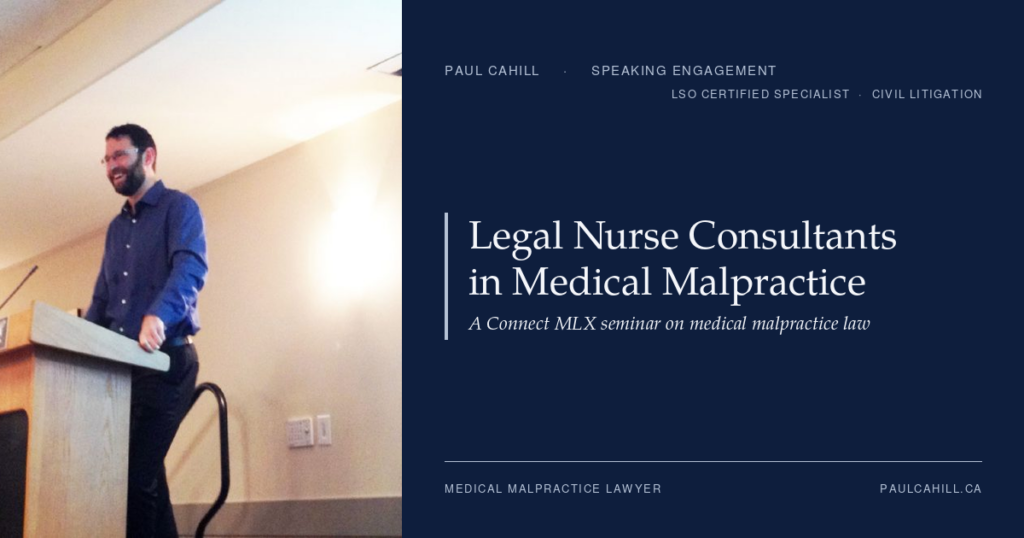
On September 14, 2015, Paul presented a seminar on the law of medical malpractice to a group of nurses enrolled in the Introduction to Legal Nurse Consulting course organized by Connect Medical Legal Experts. The course is one of the entry points in Canada for nurses moving into legal nurse consulting (LNC) work, and a session on medical malpractice law is a useful piece of the foundation those nurses are building.
Legal nurse consultants are not lawyers and are not expert witnesses. They are nurses with clinical experience who support litigation teams (on either side, although this discussion is from the plaintiff perspective) in handling the medical aspects of a case. Used well, an LNC can compress months of work for a lawyer into weeks, and can flag substantive issues that a lawyer reading records cold would miss.
Why a nurse is the right person for this work
The clinical record in a medical malpractice case is the central document. The hospital chart, the outpatient records, the imaging reports, and the medication administration records together describe what happened to the patient in the language of the people who treated them. That language is technical, abbreviated, and full of conventions that have practical meaning to a clinician and very little meaning to anyone else.
A nurse can read that record fluently. A nurse can tell, looking at vital signs and nursing notes, whether the patient’s condition was deteriorating in a way that should have prompted a call to the attending physician, whether the documented assessments are consistent with the treatment ordered, whether the medications and dosages match the orders, and whether the timing of interventions reflects the standard of nursing or medical practice. A lawyer reading the same chart without that clinical background will spend many hours and still miss things that the nurse will catch in minutes.
What a legal nurse consultant contributes
In the typical Ontario medical malpractice file, the LNC’s work includes the following.
Records organization and chronology. Hospital records arrive in non-chronological order, with multiple authors, abbreviations, and formats. An LNC produces a unified chronology that the lawyer can actually use, with each entry sourced back to the originating document.
Identification of potential deviations from the standard of care. This is not the same as the legal opinion on standard of care, which has to come from a properly qualified expert in the relevant specialty. The LNC’s role is to identify the points in the record where a deviation may have occurred, so the lawyer knows what to ask the expert about. The expert opinion is the proof; the LNC’s flag is the question.
Translation of medicine for the lawyer. Medical malpractice files turn on understanding a specific clinical problem in detail. The LNC translates the medicine into terms the lawyer can use in discoveries, in mediation, and at trial.
Support for expert retention. LNCs often know the specialty world the lawyer is trying to navigate. They can suggest categories of expert, identify which specialties speak to which questions, and help frame the questions that will be put to the retained expert.
Documentary preparation for trial. When trial approaches, the LNC’s chronology and analysis feed directly into the trial brief, the joint document brief, and the cross-examination preparation for defence experts.
What legal nurse consultants need to understand about medical malpractice law
Effective LNC work in this area sits on a foundation of legal understanding that is different from clinical training. The seminar Paul gave in 2015 covered the elements of that foundation.
Standard of care is a legal concept. A nurse with clinical experience knows what good practice looks like in their own field. The legal standard of care, however, is established through expert evidence at trial and is the standard of a reasonable practitioner in the same specialty in similar circumstances. The Supreme Court of Canada in ter Neuzen v Korn, [1995] 3 SCR 674, confirmed that the legal standard cannot generally be set by the LNC’s clinical intuition; it has to be proved through expert opinion in the right specialty. The LNC’s clinical instinct is the starting point of the analysis, not the conclusion.
Breach is not enough. Even where the standard of care is plainly breached, the plaintiff must also prove that the breach caused the injury. Causation is the most common reason that otherwise-sympathetic cases do not succeed. An LNC who has reviewed a chart and identified a clear breach is right to flag it, but the case is built only when causation can be established through the same kind of expert evidence.
Documentation is evidence. The clinical record is the contemporaneous account of what happened. Gaps in documentation, late entries, additions, and inconsistencies between authors all matter at trial. The LNC’s training to identify and flag those features of a record is directly transferable to the litigation context.
Litigation timelines are long. Medical malpractice files run four to seven years from claim to judgment. An LNC who begins work on a file at intake may still be on the file when it reaches trial. Understanding the procedural arc, from records gathering through pleadings, discoveries, mediation, expert reports, and trial, helps the LNC anticipate what will be needed at each stage.
Practical observations
The intersection of nursing knowledge and legal advocacy is a real source of value in medical malpractice practice. The best plaintiff teams in this area work closely with LNCs from the earliest stage of the file. The clinical fluency the LNC brings, combined with the lawyer’s training to convert clinical observations into pleadings, evidence, and argument, is the combination that allows a medical malpractice case to be properly investigated and prepared.
Courses like the one Connect Medical Legal Experts ran in 2015 are how that workforce gets built. A nurse coming out of one of these programs, with a working understanding of how Ontario medical malpractice law actually operates, is positioned to add immediate value to any plaintiff firm that takes the time to integrate them into the case team.