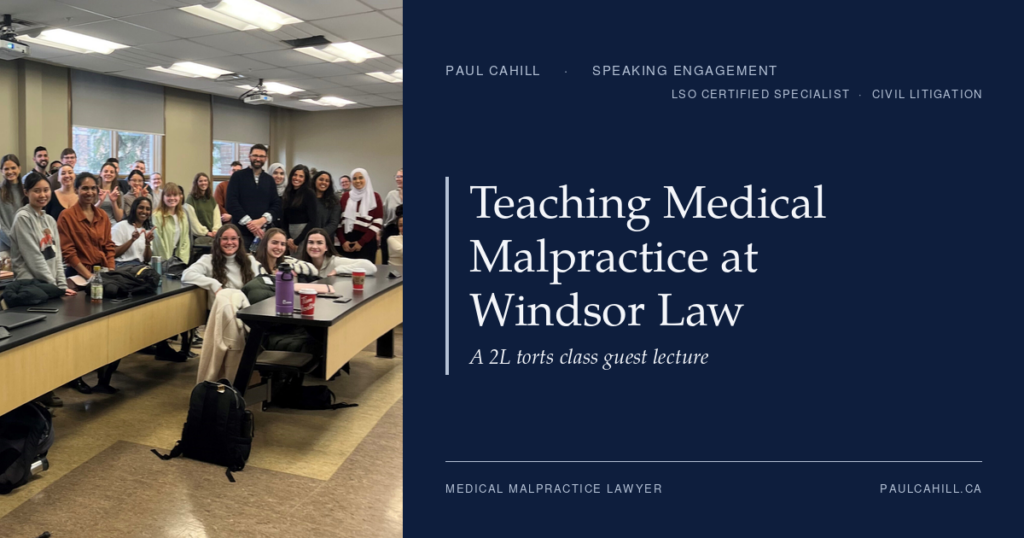
On February 6, 2023, Paul was invited to guest lecture at Professor Leann Sassine’s 2L torts class at the University of Windsor Faculty of Law. The lecture covered the essential evidence required to prove a claim in medical malpractice, drawing on Paul’s trial experience in this area of plaintiff-side civil litigation.
Medical malpractice is taught in most Canadian law schools as a discrete topic within the negligence unit of a first or second-year torts course. The classroom treatment gives students the doctrinal framework. What it cannot easily give them is a sense of what it actually takes to prove a medical malpractice claim in an Ontario courtroom: which elements are routinely contested, which are routinely conceded, which carry the most evidentiary weight, and which are most likely to determine the outcome of a case. The lecture was an attempt to bridge that gap.
The four elements, in practice
A medical malpractice claim is a species of negligence, and the elements follow the standard negligence template: duty, breach (standard of care), causation, and damages. The practical experience of running these cases shows how unevenly those four elements are contested.
Duty
Duty is almost never an issue. The physician owes a duty of care to the patient by virtue of the doctor-patient relationship; the hospital owes a duty by virtue of receiving the patient into its care; the nurse owes a duty by virtue of providing nursing services. Pleadings recite the duty, the defence admits it, and the trial moves on.
The exception is in claims where the duty itself is at the edge of the established categories: a teleconsultation between physicians, a curbside consult, a physician who reviewed records but never saw the patient, a defendant whose involvement was administrative rather than clinical. In those cases, duty becomes a threshold question that the law students may see in the casebook but the practitioner sees only rarely.
Standard of care
Standard of care is the element that absorbs most of the trial work. The Supreme Court of Canada in ter Neuzen v Korn, [1995] 3 SCR 674, confirmed that the standard is generally established through expert evidence, and is the standard of a reasonable practitioner in the same specialty in similar circumstances. The exception, for matters within ordinary common sense, is narrow.
The classroom version of standard of care is doctrinal: the Bolam-style “reasonable practitioner” framework, the role of professional norms, and the limited circumstances in which the court can find that an entire professional practice is itself substandard. The trial version is evidentiary: which expert, with which credentials, can speak to the specific clinical question; how that expert’s report will hold up to a White Burgess qualification motion; how the expert will present to a jury; and how the defence expert’s contrary opinion will be cross-examined.
Causation
Causation in medical malpractice cases is where doctrinally-correct claims fall apart with some frequency. The “but for” test from Clements v Clements, 2012 SCC 32, asks whether, on a balance of probabilities, the injury would not have occurred but for the defendant’s breach. In medical cases, that question is often hard to answer because the patient came to the encounter with an existing condition that would have produced some outcome regardless of the breach.
A patient with a serious underlying illness who would have suffered some adverse outcome even with non-negligent care presents the classic medical malpractice causation problem. The expert evidence has to address what would have happened with reasonable care, not just what did happen. That counterfactual is often where the case lives or dies. The material-contribution-to-risk alternative remains available in narrow circumstances under Clements, but it is not the default in medical malpractice files.
Damages
Damages in medical malpractice claims follow the standard heads of personal injury recovery: general damages (capped under the Andrews trilogy framework), past and future loss of income, past and future cost of care, and dependants’ claims under the Family Law Act, RSO 1990, c F.3. The cases that warrant the substantial investment of plaintiff-firm resources are typically catastrophic-injury or fatality cases where the damages, after costs, leave the patient or surviving family meaningfully better off.
Law students see the damages framework as an analytical exercise. Practitioners see it as the threshold question at intake: does this case have damages sufficient to fund the investigation. The screening point precedes the doctrinal one in real-world practice.
Expert evidence as the connective tissue
The four elements are doctrinally distinct but evidentially linked through the expert who is retained. The same expert often speaks to standard of care, breach, and causation; damages is typically the domain of separate damages experts (functional, vocational, economic, future-care). The expert’s quality, independence, and credibility shape the outcome of all three of the elements they testify on. A weak expert costs the plaintiff on every element they address; a strong expert is the difference between a viable case and a losing one.
This is the point that law students take longest to internalize. The textbook treatment of medical malpractice describes the elements as discrete legal questions. The trial reality is that the same expert is testifying on most of them at once, and the case is being decided as much on the persuasiveness of that expert as on the doctrinal merits of the claim.
Practical observations
Guest lectures of this kind are a small contribution to a larger purpose. The plaintiff bar in medical malpractice in Ontario is small and specialized, and the students sitting in a 2L torts class are the next generation of the practitioners who will do this work. Giving them a sense of what trial work in this area actually looks like, beyond the doctrinal framework, is part of how the specialty replenishes itself.
The students at Windsor Law in February 2023 were a thoughtful audience and asked good questions. The lecture, like all teaching, was useful for the teacher as well: explaining the practical realities of a specialized practice to a smart non-expert audience is a discipline that sharpens the practitioner’s own thinking. Worth the drive.