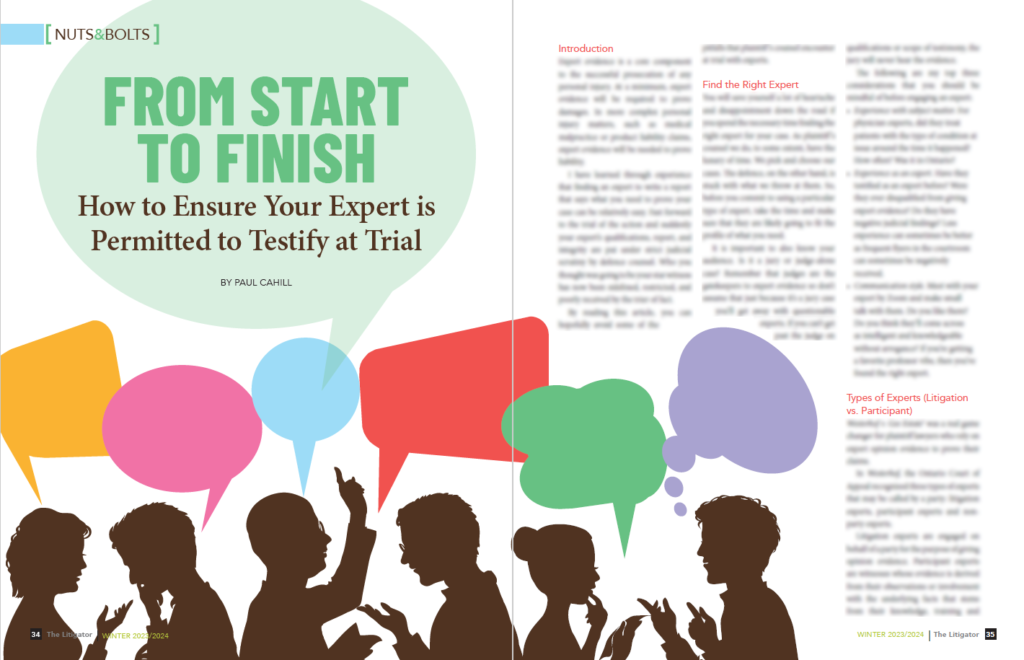
Paul’s article “From Start to Finish: How to Ensure Your Expert is Permitted to Testify at Trial” was published in the Winter 2023/2024 edition of The Litigator, the flagship publication of the Ontario Trial Lawyers Association. The article addresses one of the most consequential procedural questions in plaintiff personal injury and medical malpractice litigation: how to navigate the expert qualification process so that the experts retained for trial are actually permitted to give the opinion evidence they were retained to give.
Why expert qualification matters
In medical malpractice litigation, expert evidence is the foundation of the plaintiff’s case. The standard of care, breach of that standard, and causation almost always require qualified expert testimony. A case in which the expert evidence is excluded or substantially restricted is generally not a viable case. The qualification stage — the threshold admissibility analysis the trial judge undertakes before the expert is permitted to give opinion evidence — is therefore one of the most important moments in any malpractice trial.
The leading framework is set out in White Burgess Langille Inman v Abbott and Haliburton Co, 2015 SCC 23, which articulated a two-stage analysis. At the threshold stage, the proposed expert must be properly qualified to give the opinion evidence proposed, the evidence must be relevant, the evidence must be necessary to assist the trier of fact, and there must be no exclusionary rule that applies. At the second stage, the trial judge exercises a residual discretion to weigh the probative value of the evidence against its prejudicial effect, with the expert’s independence and impartiality being a relevant factor.
The framework operates with real consequence in malpractice cases. An expert who is properly qualified can support the case at trial. An expert who is not properly qualified, or who is partially qualified with substantial restrictions on scope, can leave the plaintiff without the evidence the case requires.
What the article covers
The article addresses the practical questions that arise across the lifecycle of an expert engagement in a personal injury or medical malpractice case:
Types of experts. Canadian civil procedure recognizes distinct categories of expert. Litigation experts are retained specifically for the purpose of providing opinion evidence at trial; the formal Rule 53.03 framework in Ontario applies to them. Participant experts are experts who were involved in the underlying events (a treating physician, for example, whose clinical opinions formed part of the patient’s care); their evidence is admissible under a different framework. Non-party experts are those whose opinions exist outside the litigation context but may become relevant. The article walks through each category and the procedural requirements that operate.
The qualification stage. The article addresses what the trial judge actually does at qualification: assessing whether the expert’s training, experience, and methodology meet the threshold; whether the proposed opinion is within the expert’s expertise; whether the evidence is necessary; and whether the independence and impartiality requirements are satisfied.
Defence strategies. The article addresses the recurring defence strategies to exclude or restrict expert evidence: challenging qualifications (insufficient expertise in the specific subject matter), challenging independence (bias toward the retaining party), challenging the scope of the proposed opinion (going beyond the expertise), challenging methodology (not based on accepted scientific or clinical principles), late disclosure objections (failure to comply with Rule 53.03 timing requirements), and hearsay objections (the expert relying on inadmissible facts).
The framework is the same in every malpractice case at trial. Plaintiff counsel preparation for qualification is one of the central tasks of trial preparation in this area.
How the article connects to the cases on this site
The expert evidence framework operates in essentially every case in the rewritten case-comment cluster on this site. A handful of cases illustrate the framework with particular clarity:
- Beazley v Johnston is the most direct illustration of the White Burgess framework operating against a plaintiff. The proposed expert was disqualified entirely; the substitute expert had standing problems; the case was dismissed on summary judgment.
- Hanson-Tasker v Ewart is a BC Court of Appeal decision in which substantial competing expert evidence displaced the plaintiff’s invocation of the Snell v Farrell adverse inference. The doctrinal point is that the qualification of expert evidence is one thing; the persuasiveness of that evidence at trial is another, and both matter.
- Knight v Lawson, a case I tried, illustrates that even where standard-of-care expertise is available and accepted, causation expert evidence is a separate question that can be the controlling issue at trial.
- Tripp v Ross shows the central role of oncology expert evidence in determining whether a delay in cancer diagnosis caused the death — and the doctrinal lesson that expert evidence on the natural history of the underlying disease is often the most outcome-determinative feature.
- 2023 in Review: Self-Represented Litigants documents what happens at the other end of the spectrum: where no expert evidence is available at all, the case generally cannot succeed on summary disposition.
Each of these cases turns, at least in part, on the framework that the Litigator article addresses.
About The Litigator
The Litigator is the flagship publication of the Ontario Trial Lawyers Association, the professional association representing personal injury and civil litigation lawyers in Ontario. The journal has been published since 1992 and is one of the principal venues for substantive professional writing by the Ontario plaintiff-side litigation bar.
Articles in The Litigator are available to OTLA members. Information about OTLA membership is available at otla.com.
About the author
Paul is a partner at Davidson Cahill Morrison LLP and an LSO Certified Specialist in Civil Litigation. His trial work includes an $11.5 million jury verdict in a cerebral palsy case (Woods v Jackiewicz) and a successful trial against an emergency room physician in a case involving the preventable death of a 34-year-old mother of four. He is recognized in Best Lawyers in Canada for Medical Negligence. For more on Paul’s practice, see About Paul or the Notable Cases section.
For more on medical malpractice litigation in Ontario, see Suing for Medical Malpractice in Ontario: What You Need to Know. For guidance on selecting counsel, see Choosing a Medical Malpractice Lawyer.
Publication: The Litigator, Winter 2023/2024 edition
Publisher: Ontario Trial Lawyers Association (OTLA)
Article title: “From Start to Finish: How to Ensure Your Expert is Permitted to Testify at Trial”
Author: Paul Cahill