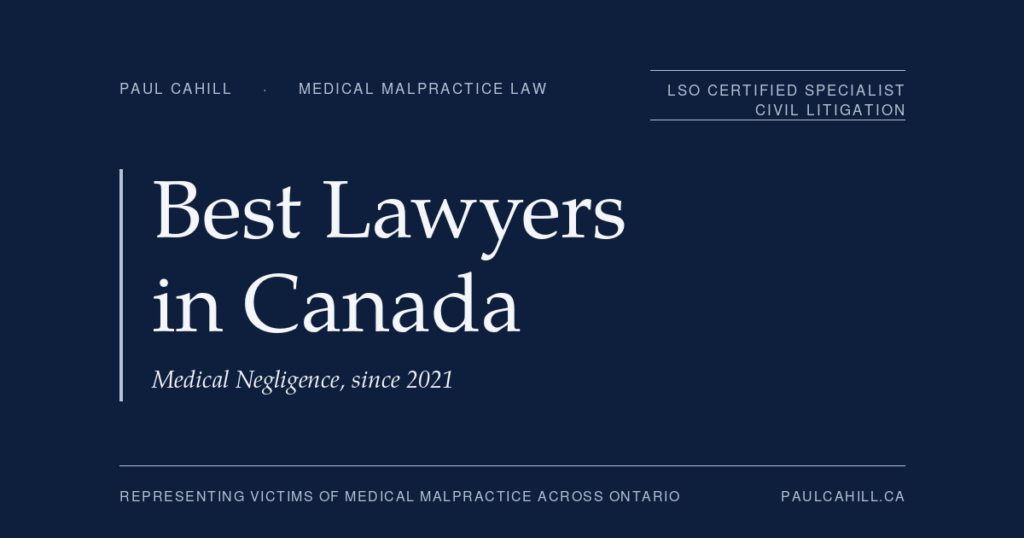
Paul Cahill has been recognized by Best Lawyers in Canada in the Medical Negligence practice area each year since 2021.
Best Lawyers is a peer-review legal directory that has been published since 1981. It is one of the oldest and most established peer-review publications in the legal profession. Recognition is based on confidential evaluations by other practising lawyers in the same area of practice. Lawyers cannot pay to be included, and the methodology is designed to identify lawyers whose peers regard them as among the strongest practitioners in their field. Lawyers who are recognized in one edition must continue to receive sufficient peer support in subsequent surveys to remain in future editions.
The Medical Negligence practice area is one of the more specialized listings in the directory. The lawyers recognized in this category in any given year are a small group, typically counsel who spend the majority of their practice on plaintiff-side or defence-side medical negligence work. In Ontario, where the defence side of medical malpractice is dominated by the Canadian Medical Protective Association (CMPA), the plaintiff bar is comparably specialized, and consistent peer recognition over multiple years is a useful indicator of standing in the area.
What peer recognition signals
Peer-review legal directories are imperfect. They reflect the views of the lawyers surveyed, which may not always align with the views of clients who have actually worked with a given lawyer. They are not, on their own, a substitute for the more concrete indicators of trial experience, clinical depth, and case results that should drive a prospective client’s evaluation of counsel.
What peer recognition does signal, when consistent over time, is professional standing in the area. A lawyer who has been recognized in the same specialized category each year for multiple consecutive years is a lawyer whom other practitioners in the same field have repeatedly identified as a leader in the work. That is meaningful corroborating evidence, even if it is not the only evidence.
Paul also holds the Law Society of Ontario Certified Specialist designation in Civil Litigation, a separate peer-validated credential awarded by the Law Society itself on the basis of substantial and ongoing experience in the specialty, peer review, and continuing education in the area. The two credentials taken together (Best Lawyers in Canada in Medical Negligence and LSO Certified Specialist in Civil Litigation) reflect substantive professional standing in the medical negligence field.
What this means for prospective clients
For someone considering whether to retain a particular lawyer for a medical malpractice claim, peer-review credentials are one of several useful inputs alongside trial experience, reported decisions, references, and the lawyer’s response in the first consultation. For a fuller discussion of how to evaluate counsel in this area, see How to Choose a Medical Malpractice Lawyer in Ontario, which sets out a framework for evaluating any prospective lawyer (including Paul) on the substantive criteria that matter most.
Paul’s track record as plaintiff’s counsel is reflected in the Notable Cases page, which links to the reported decisions in each. For commentary on recent Ontario medical malpractice and regulatory discipline jurisprudence, see the blog. For an introduction to the framework of medical malpractice claims in Ontario more generally, see Suing for Medical Malpractice in Ontario: What You Need to Know.