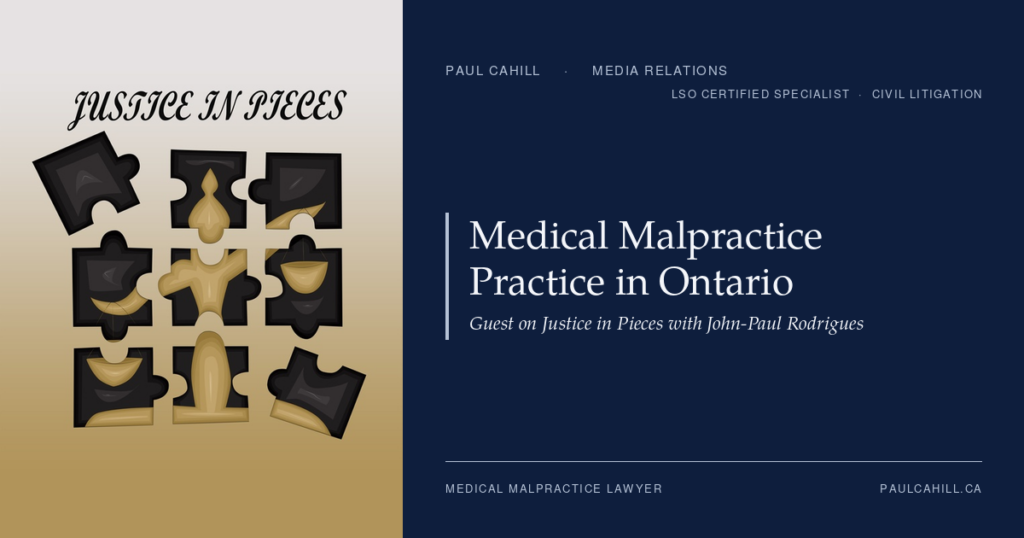
On November 24, 2021, Paul was an invited guest on Justice in Pieces, the legal education series hosted by John-Paul (J.P.) Rodrigues. The conversation, published on the Justice in Pieces YouTube channel, focused on the practice of law in Ontario with particular attention to medical malpractice litigation. The format was a discussion pitched at the audience the series is built for: paralegal students, law students, newly licensed paralegals, and newly licensed lawyers thinking about what plaintiff-side civil litigation actually looks like as a career.
About Justice in Pieces
Justice in Pieces was launched by John-Paul Rodrigues in March 2020 as a legal resource for paralegal and law students. The format is a guest speaker series in which Rodrigues interviews lawyers, paralegals, judges, public officials, and others about their practice and their work. The series has grown into a substantial educational asset, with several hundred guests over its run.
Past guests have included federal political figures (NDP Leader Jagmeet Singh, the Honourable Andrew Scheer, MP Elizabeth May), the Honourable Doug Downey (Attorney General of Ontario), Mayor Patrick Brown, the Honourable Lori Anne Thomas, and a long list of practitioners across the bar. The unifying thread is the audience: students and early-career professionals who want to hear from people doing the work, rather than reading about the work from a textbook.
The series is hosted on the Justice in Pieces YouTube channel and is supported by a website at justiceinpieces.ca that includes resources for licensing examination preparation and other professional development materials.
The conversation
The Justice in Pieces episodes are conversational rather than scripted, and Paul’s episode followed that format. The discussion ranged across the practice questions that students and early-career lawyers ask about plaintiff-side medical malpractice work in Ontario: how cases are screened and selected, how the CMPA-defended landscape shapes plaintiff strategy, what expert evidence looks like in this work, how cases are built and tried, and what the trial experience is actually like from counsel’s chair.
For an audience considering whether to do this kind of work, the practical realities are often more useful than the doctrinal architecture. The doctrinal architecture is in the textbooks and case law. The practical realities (how files are managed over years, how relationships with experts develop, how disbursements compound, how trials are paced and how juries actually respond to medical evidence) are harder to find without speaking to someone who has been through it. The Justice in Pieces format is designed to make that kind of conversation accessible.
The audience and the format
Justice in Pieces sits in an interesting place in Canadian legal education. The traditional CLE landscape is built around licensed lawyers and paralegals who already have a practice and want to deepen specific areas of expertise. The student-focused content available through law schools and paralegal programs tends to be academic. There is relatively little programming that addresses the in-between space: students who are about to enter practice and want to hear what practice is actually like from practitioners who can speak to it without filtering through institutional considerations.
That gap is what Justice in Pieces fills. The format is open enough to make space for the unglamorous parts of practice (the years of pre-trial work, the file management, the economics of a contingency practice) while still being useful as introductory content for someone trying to decide what kind of lawyer they want to be.
For Paul, the appearance fit a broader pattern of education work that has run alongside his trial practice for years: lectures at law schools, presentations at CLE conferences, paper authorship for the OTLA Litigator and similar publications, and conversations like this one. The audience for each is different, but the underlying conviction is the same: that plaintiff-side medical malpractice practice in Ontario is a small specialty whose maintenance depends on its practitioners being willing to teach the work to the people coming up behind them.
Where to watch
The full conversation is available on the Justice in Pieces YouTube channel at youtube.com. More information about the Justice in Pieces series, including its archive of past episodes and its resources for paralegal and law students, is available at justiceinpieces.ca.
Context
At the time of the November 2021 conversation, Paul was a partner at Will Davidson LLP. The firm restructured later, and Paul is now a partner at Davidson Cahill Morrison LLP. The medical malpractice practice Paul described in the conversation has continued and deepened in the years since.