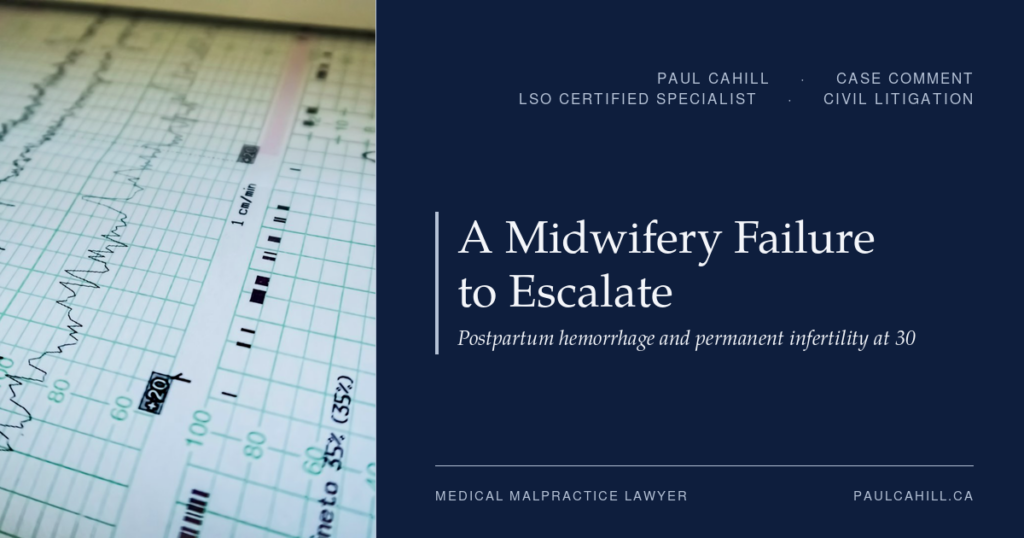
In December 2025, Paul Cahill settled a medical malpractice claim on behalf of a 30-year-old woman whose midwifery-led labour and delivery did not escalate to obstetrical consultation when the clinical signs required. The labour showed persistent signs of dystocia and the fetal heart patterns moved out of the normal range and into the atypical and abnormal range. Each finding is a recognised trigger in the midwifery standard-of-care framework for at least consultation with an obstetrician. The consultation was delayed. By the time the patient was transferred to obstetrical care, the conditions that had developed during labour produced a severe postpartum hemorrhage, which proceeded to hypovolemic shock. The bleeding could not be controlled by the usual measures, and an emergency hysterectomy was performed to save her life. The hysterectomy is permanent. The patient is now infertile at age 30 and, with her partner, is facing the loss of the additional children she had planned to have. The path forward to building her family runs through surrogacy. The case settled before trial. The terms are confidential.
The case is doctrinally useful for what it illustrates about the standard of care in midwifery practice and about the framing of damages in a young patient whose injury is reproductive rather than musculoskeletal or neurological. The standard of care issue turns on the duty of a midwife to recognise the clinical signs that fall outside the scope of midwifery practice and to consult or transfer care in a timely manner. The damages issue turns on the long-term consequences of permanent infertility in a young patient with a planned family that has been disrupted, including the substantial future costs associated with surrogacy and assisted reproductive technology.
The regulatory context: midwifery in Ontario
Midwifery is a regulated health profession in Ontario. The profession is governed by the Midwifery Act, 1991, SO 1991, c. 31, and oversight is provided by the College of Midwives of Ontario. Registered midwives in Ontario provide primary care for low-risk pregnancy, labour, birth, and the early postpartum period. The scope of practice is defined by section 3 of the Midwifery Act and the authorised acts are set out in section 4. Midwives are autonomous primary care providers within their scope, but the scope is bounded. When complications arise that fall outside the scope, the duty to consult with or transfer care to a physician — typically an obstetrician — is a defining feature of the profession’s place in the broader maternity care system.
The CMO’s regulatory framework for the escalation decision has evolved. The College historically maintained prescriptive standards that catalogued clinical circumstances in which discussion, consultation, or transfer of care was required. The Consultation and Transfer of Care Standard (November 2015) and the Induction and Augmentation of Labour Standard (July 2014) were of this kind. Beginning in 2018, the College moved to a principles-based regulatory model and the more prescriptive clinical standards were rescinded or archived in the years that followed. The current operative instrument is the Professional Standards for Midwives (approved March 2018, current version effective June 1, 2021). Principle 28 of the Professional Standards requires a midwife to consult with or transfer care to another care provider when the care a client requires is beyond the midwifery scope of practice or exceeds the midwife’s competence, unless not providing care could result in imminent harm. Principle 23 makes a midwife accountable for clinical decisions and the actions that flow from them. The College’s principles-based standards do not catalogue the clinical findings that trigger escalation; the application of the principles to a specific labour is left to the midwife’s clinical judgment, informed by the published clinical practice guidelines that govern obstetrical and midwifery care in Ontario.
The Association of Ontario Midwives publishes Clinical Practice Guidelines that operate as profession-authored guidance on the management of specific clinical situations. Hospital-level rules — medical staff bylaws, midwifery privileges, and departmental policies — set additional context for the practice of midwifery in any given institution. The standard of care for a specific labour will turn on the integration of the CMO’s principles-based standards, the relevant AOM and SOGC clinical practice guidelines, hospital-level policy, and expert evidence from a midwife of equivalent training and experience to the defendant.
Where the alleged events pre-date the 2018 shift to principles-based regulation, the more prescriptive CMO standards in effect at the relevant time provide the operative reference. The applicable framework for any given case turns on the date of the events and the regulatory instruments operative at that time.
The clinical context: labour dystocia
Labour dystocia is a term covering several patterns of abnormal labour progress. The clinical understanding of normal labour progress has been substantially revised over the past fifteen years. The Friedman-curve framework, which underpinned the older guidance and described the active phase of the first stage as beginning around 4 cm with a normal rate of cervical dilation of approximately 1 cm per hour, has been challenged by the Zhang data, which describes normal labour as proceeding more slowly and the active phase as beginning closer to 6 cm. The contemporary obstetrical literature reflects this revision, with implications for how dystocia is identified and managed in current practice.
In a midwifery-led labour, persistent dystocia — once identified through the application of contemporary criteria — is generally an indication for consultation with an obstetrician, because the management options can extend beyond what is safely accomplished within midwifery care. The scope question itself has evolved on this point: under the current Designated Drugs and Substances Regulation, O. Reg. 188/24, Ontario midwives may administer oxytocin for induction and augmentation on their own authority, and the AOM has supported midwives maintaining primary care in those circumstances. The case-specific question is whether the management decision called for in the labour at issue could be safely accomplished within the midwifery scope, or whether obstetrical involvement was required.
The clinical context: fetal health surveillance
Intrapartum fetal health surveillance in Ontario is governed by the Society of Obstetricians and Gynaecologists of Canada’s clinical practice guideline on the subject. The current guideline is SOGC Clinical Practice Guideline No. 396, Fetal Health Surveillance: Intrapartum Consensus Guideline (Dore & Ehman, J Obstet Gynaecol Can 2020;42(3):316–348). The SOGC framework classifies electronic fetal monitoring tracings in three categories — normal, atypical, and abnormal — and intermittent auscultation findings as normal or abnormal.
A normal EFM tracing exhibits a baseline rate between 110 and 160 beats per minute, moderate baseline variability, accelerations either present or absent, and decelerations either absent or limited to early or uncomplicated variable decelerations. An atypical tracing shows features that warrant continued evaluation and consideration of intrauterine resuscitation: examples include minimal variability for prolonged periods, recurrent uncomplicated variable decelerations, atypical variable decelerations, or a single prolonged deceleration greater than two minutes. An abnormal tracing shows features that generally require expedited delivery or other definitive intervention: examples include absent variability with recurrent late or complicated variable decelerations, bradycardia, sinusoidal patterns, or a prolonged deceleration greater than ten minutes.
Where an atypical or abnormal tracing is identified, the clinical task is intrauterine resuscitation — maternal repositioning, intravenous fluids, oxygen, discontinuation of oxytocin if running, scalp stimulation — and escalation of care if the pattern does not improve. In midwifery-led labour, abnormal tracings, and atypical tracings that persist or worsen, are recognised indications for consultation with an obstetrician under both the CMO’s principles-based standards and the SOGC guidance.
The U.S. National Institute of Child Health and Human Development three-category framework (Category I/II/III) is the American equivalent and is sometimes referenced in Canadian materials. It is not the framework used in Canadian intrapartum care; Ontario hospitals, midwifery practices, and obstetrical experts document and reason in the SOGC framework. The applicable terminology in an Ontario litigation context is the SOGC’s.
The clinical context: postpartum hemorrhage and emergency hysterectomy
Postpartum hemorrhage is the leading cause of maternal death worldwide. The current SOGC guideline on PPH is Guideline No. 431, Postpartum Hemorrhage and Hemorrhagic Shock (Robinson et al., J Obstet Gynaecol Can 2022;44(12):1293–1310, replacing No. 235 from 2009 and No. 115 from 2002). The 2022 guideline moves away from the older binary definitions framed by a 500 mL or 1000 mL threshold and adopts a staging-based approach driven by quantitative blood loss together with clinical signs of hemodynamic compromise. The goal of the staging framework is earlier recognition of evolving PPH before it reaches the volumes associated with severe morbidity. The guideline also emphasises quantitative measurement of blood loss over visual estimation, which has long been recognised to underestimate actual blood loss.
The principal causes of postpartum hemorrhage are summarised in the well-known “Four Ts” framework:
- Tone: uterine atony, the failure of the uterus to contract effectively after delivery. This is the most common cause of postpartum hemorrhage. Atony is more likely after prolonged labour (the uterine muscle becomes fatigued), after augmented or induced labour, in the presence of chorioamnionitis, after delivery of a large baby or multiple babies, and in patients with a history of prior atony.
- Trauma: lacerations of the genital tract, including cervical and vaginal lacerations and extensions into the broad ligament. Trauma is more likely in operative vaginal deliveries and in deliveries through unfavourable maternal anatomy.
- Tissue: retained placenta or retained placental fragments. The uterus cannot contract effectively when tissue remains in the cavity.
- Thrombin: coagulopathy, either pre-existing or acquired during labour and delivery, including disseminated intravascular coagulation, which can develop as a complication of severe hemorrhage itself.
The management of postpartum hemorrhage proceeds in a recognised stepwise fashion: uterine massage, uterotonic medications (oxytocin, carbetocin, ergot alkaloids such as methylergonovine, carboprost, and misoprostol), tranexamic acid given within three hours of birth, bimanual uterine compression, intrauterine balloon tamponade, examination for and repair of lacerations, removal of retained tissue, and, where bleeding cannot be controlled by these measures, surgical intervention. The surgical options include uterine artery ligation, internal iliac artery ligation, B-Lynch or other compression sutures, and, as a last resort, hysterectomy.
Emergency peripartum hysterectomy is a life-saving procedure when other measures have failed to control bleeding. It is permanent and ends the patient’s fertility. The published obstetric literature treats emergency peripartum hysterectomy as an end-of-the-line intervention reserved for cases where the alternative is exsanguination.
The clinical link between the elements of this case is well-recognised. Prolonged or dysfunctional labour produces uterine atony, the most common cause of postpartum hemorrhage. Delays in escalation extend the duration of labour, compound the risk of atony, and may also delay the recognition of the developing hemorrhage once it begins. On the plaintiff’s case theory, earlier escalation to obstetrical care, in a labour with the features that triggered the duty to consult, would have produced a different chain of events: either an earlier delivery (avoiding the cumulative effect of prolonged labour) or earlier recognition of the hemorrhage and a less drastic intervention than emergency hysterectomy.
The patient and the breach
The patient was 30 years old at the time of the events. She and her partner had a planned family that included additional children beyond the one whose birth was managed by the midwives. The midwifery care was provided by registered midwives in Ontario. The labour was the kind of clinical situation that the midwifery scope of practice was designed to handle, until it was not.
The labour developed persistent signs of dystocia. The fetal heart tracings progressed into the atypical and then abnormal range under the SOGC framework. On the plaintiff’s case theory, the consultation called for was not made when it should have been. The labour continued without obstetrical involvement for longer than the standard would have permitted.
When the consultation was eventually made and the patient was transferred to obstetrical care, the clinical situation had deteriorated. The postpartum period was complicated by severe hemorrhage. The bleeding could not be controlled by uterotonics, bimanual compression, or other conservative measures. The patient developed hypovolemic shock. The decision was made to perform an emergency hysterectomy. The hysterectomy controlled the bleeding and saved the patient’s life. It also ended her ability to bear additional children.
The standard of care
The standard of care for midwifery practice in Ontario is established through expert evidence at trial. The expert is typically a registered midwife of equivalent training and experience to the defendant. Obstetrical evidence is relevant to context, particularly to the consequences of delays in obstetrical involvement and the management decisions that fell to the obstetrical team after transfer of care, but the comparator standard for the conduct of a midwife is the practice of a reasonably competent midwife in similar circumstances.
The foundational Canadian articulation of the professional standard of care is Crits v. Sylvester, [1956] SCR 991, aff’g [1956] OR 132 (Ont CA), which holds that a professional must exercise the degree of skill, care, and knowledge of an average member of the profession in good standing in similar circumstances. The Supreme Court in Ter Neuzen v. Korn, 1995 CanLII 72 (SCC), [1995] 3 SCR 674, applied Crits in the context of medical negligence and held that conformity with the customary practice of the profession is generally a defence, but is not determinative where the practice itself is fraught with risks so obvious that no reasonably competent professional would have followed it. The court is the ultimate arbiter of whether the conduct fell below the standard, informed by the expert evidence on customary practice.
Applied to midwifery, this framework requires evidence of what a reasonably competent registered midwife in similar circumstances would have done. The CMO’s published Professional Standards provide a reference framework, and the published clinical practice guidelines from the SOGC and the AOM provide further reference material for the expert’s opinion. None of these documents is dispositive of the standard of care at common law. The expert evidence at trial would have addressed the recognition of the clinical signs, the application of the standards to those signs, the timing of the escalation decision, the communication with consulting physicians, and the documentation of the decision-making.
The legal framework
A malpractice claim arising from a midwifery failure to escalate is analysed within the standard negligence framework, with attention to the specific features of midwifery practice.
Duty of care. The duty of care owed by a midwife to a patient in her care extends to the recognition of clinical signs that require escalation and to the timely escalation itself. This element is uncontested in cases of this type.
Standard of care. The standard for midwifery practice, as discussed above, is established through expert evidence and applied to the specific clinical decisions at issue.
Causation. The causation analysis would have addressed whether earlier escalation would have produced a materially different outcome. The plaintiff’s case would have rested on expert obstetric and midwifery evidence that earlier obstetrical involvement would have led to earlier delivery (avoiding the cumulative effect of prolonged labour on uterine tone), earlier recognition of the developing hemorrhage, or a less drastic intervention than emergency hysterectomy. The “but for” test from Clements v. Clements, 2012 SCC 32, [2012] 2 SCR 181, would have been applied to each counterfactual. The defence position would have explored whether earlier escalation would have produced a meaningfully different outcome on the balance of probabilities, drawing on the recognised baseline clinical risks of severe postpartum hemorrhage and emergency hysterectomy that exist even in well-managed labours.
Damages. The damages in this case are substantial. The patient was 30 years old at the time of the events with a long remaining life expectancy. The damages framework includes:
- Past medical costs of the emergency hysterectomy and the postpartum recovery, including the cost of intensive care for hypovolemic shock and the cost of subsequent obstetric and psychological care.
- Future medical costs for ongoing care related to the consequences of hysterectomy at a young age, including hormone management, monitoring for premature menopause-related complications, and ongoing gynaecological care.
- The cost of surrogacy as the path forward to building the planned family. Surrogacy in Canada operates under the Assisted Human Reproduction Act, SC 2004, c. 2, which prohibits commercial surrogacy but permits altruistic surrogacy. The costs of altruistic surrogacy include the legal and administrative costs of the surrogacy agreement, the medical costs of in vitro fertilization (whether using the patient’s oocytes where possible, or donor oocytes), the reimbursable expenses of the surrogate (medical costs, travel, certain household expenses), and the costs of obstetric care for the surrogate pregnancy. The total cost of a single surrogacy arrangement in Canada is typically in the range of $80,000 to $150,000 or higher, depending on the specific circumstances. For a couple who had planned to have multiple additional children, the cumulative cost of multiple surrogacy arrangements can be substantial.
- Past and future loss of income, depending on the patient’s employment trajectory and the impact of the surgery and recovery on her capacity to work.
- Pain and suffering, including the psychological injury of the traumatic delivery, the diagnosis of permanent infertility at a young age, the loss of the planned family, and the ongoing emotional consequences. The published trauma literature recognises pregnancy and birth trauma as a distinct category of psychological injury with predictable patterns of post-traumatic stress, anxiety, and depression. The literature on reproductive grief recognises that the loss of fertility produces a distinct grief pattern that is often re-triggered by life events.
- Family Law Act claims by the patient’s partner for loss of care, guidance, and companionship, and for the partner’s own emotional injury. The partner’s role in the planned family and the disruption of the family-building plan support a substantial FLA claim.
Limitations. The basic limitation period in Ontario is two years from the date the claim is discovered. Discoverability under section 5 of the Limitations Act, 2002, S.O. 2002, c. 24, Sch. B turns on when the plaintiff knew or ought to have known of the injury, that it was caused by an act or omission, that the act or omission was that of the person against whom the claim is made, and that a proceeding would be an appropriate means to remedy the injury. Section 5(2) sets out a rebuttable presumption that a claim is discovered on the day the act or omission occurred, and section 15 provides an ultimate limitation of 15 years.
The resolution
The matter resolved by settlement in December 2025. The settlement was reached before trial. The terms are confidential. The settlement reflects both parties’ assessment of the standard-of-care, causation, and damages evidence, weighed against the magnitude of the damages and the risks and costs of trial.
Why this matters
For patients in midwifery-led care, the lesson is that midwifery practice is structured around a defined scope, and the duty to escalate when that scope is exceeded is one of the defining features of the profession. A patient or family member who has concerns about the trajectory of a labour is entitled to ask about the escalation considerations: whether the clinical signs warrant obstetrical involvement, what the threshold is for transfer of care, and what the basis is for the midwife’s current management plan. Asking these questions is not a challenge to midwifery professionalism; it is engagement with the same clinical question the midwife is supposed to be asking.
For midwifery practice in Ontario, this case illustrates the clinical and doctrinal importance of the escalation decision. The CMO’s principles-based regulatory framework leaves the application of the duty to consult or transfer largely to the midwife’s clinical judgment, informed by the SOGC and AOM guidelines that govern the relevant aspects of practice. Documentation of that judgment — the clinical findings considered, the decision made, the rationale, and the communication with consulting physicians — is doctrinally important for both clinical and litigation purposes.
For the broader practice of medical malpractice litigation in Ontario, this case is the first explicitly midwifery-negligence case in the notable-cases library and the first case in the library involving a maternal injury rather than a fetal or neonatal injury arising from the labour. The doctrinal frameworks for the two kinds of cases are similar in their overall structure (duty, standard of care, causation, damages) but the substantive content of each element is distinct. The damages framework in particular is distinctive: permanent infertility at a young age, with surrogacy as the path forward to building the planned family, produces a damages profile that requires careful expert and economic evidence to quantify.
For prospective clients who have experienced a serious maternal injury during a midwifery-led labour, the threshold question is whether the standard of care for escalation was met. The labour records, the fetal heart tracings, the midwifery documentation, the consultation records, and the obstetric records from any subsequent transfer of care are the starting points for the analysis. The basic limitation period in Ontario is two years from discovery, subject to the discoverability analysis under section 5 of the Limitations Act, 2002.
Settlement Date: December 2025
Settlement Type: Confidential settlement before trial
Defendants: Registered midwives (not named)
Counsel for the plaintiff: Paul J. Cahill