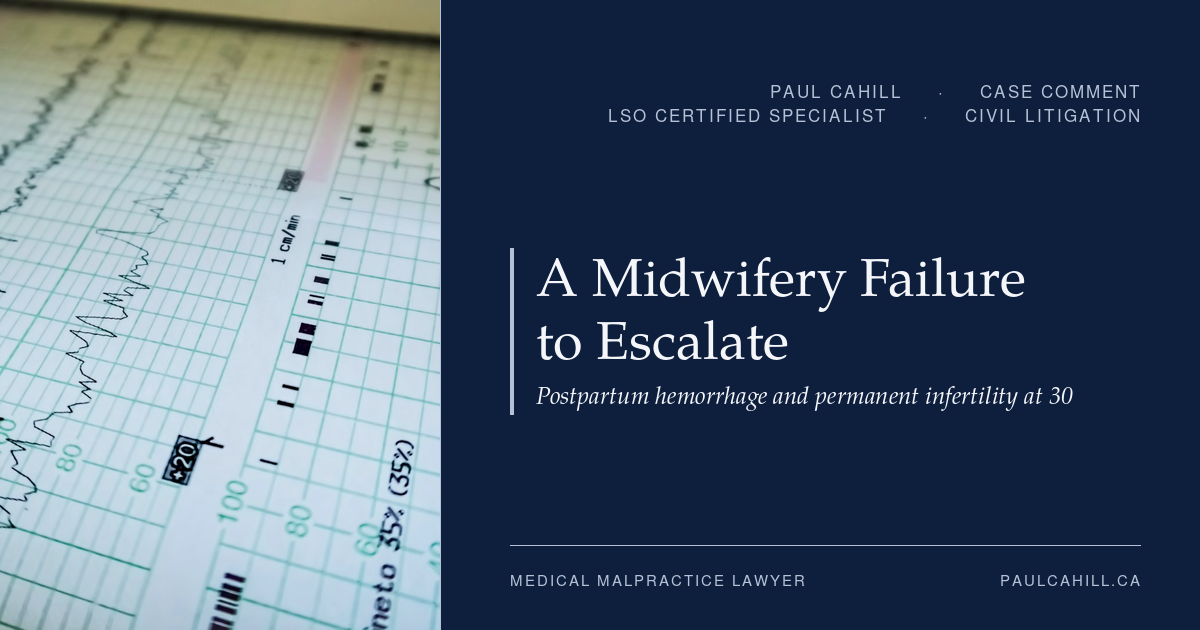
A Midwifery Failure to Escalate, a Postpartum Hemorrhage, and Permanent Infertility at 30
Ontario midwifery negligence case study: failure to escalate to obstetrical consultation, postpartum hemorrhage, emergency hysterectomy, infertility at 30.
Representing Victims of Medical Malpractice Across Ontario
Failure-to-diagnose claims arise when the relevant practitioner did not identify the patient’s condition at all. The condition may have been later diagnosed by a different practitioner, on a subsequent visit, or only at the point at which complications made the underlying problem unavoidable. The category is distinct from delayed diagnosis (where the correct diagnosis was eventually reached, but too late to prevent harm) and from misdiagnosis (where a different and wrong diagnosis was made).
Common contexts include cancer (where suspicious lesions or test results were not investigated), cardiac and vascular emergencies (where chest pain, weakness, or limb symptoms were not recognized), neurological emergencies (where headache, sensory loss, or weakness was not investigated), and infectious processes (where sepsis or appendicitis was not identified). The standard of care analysis in a failure-to-diagnose case typically focuses on what a reasonable practitioner in the same circumstances would have considered in the differential diagnosis, what investigations they would have ordered, and what further history they would have taken. The causation analysis typically focuses on what difference earlier diagnosis would have made to the outcome.
Posts tagged Failure to Diagnose analyze Ontario decisions involving a complete failure to identify a clinical condition that should have been recognized, across multiple specialties.

Ontario midwifery negligence case study: failure to escalate to obstetrical consultation, postpartum hemorrhage, emergency hysterectomy, infertility at 30.

A settlement on behalf of a patient diagnosed with terminal metastatic cancer based on imaging alone, who lived for an extended period under a wrong diagnosis.

Ontario ER physician suspended after sending home a 19-year-old with a peritonitic abdomen; she died of septic shock. CPSO v Duic, 2025 ONPSDT 11.

Ontario court denies defendant doctors’ motion for in-home security camera recordings in catastrophic injury malpractice action. Privacy prevails over relevance.

Ontario Superior Court dismisses fatal aortic dissection claim against internist and ED physician. The standards of care for mild aortic dilation and hypertensive chest pain.

Justice Williams awards over $1M in costs against the unsuccessful plaintiff in the Lyme disease malpractice trial. The defendant-win costs framework in Ontario.

The Court of Appeal affirmed plaintiff causation in a stroke malpractice case, holding that defendants cannot rely on evidentiary gaps their own negligence created.

A settlement on behalf of a woman in her 60s whose family physician dismissed three years of GI symptoms despite a known family history of colon cancer.

Cauda equina syndrome is a surgical emergency. The legal claims that follow are almost always about whether the diagnosis and treatment were timely enough.

A settlement on behalf of the family of a 39-year-old mother of two whose breast cancer was diagnosed too late after a missed opportunity to investigate.

A settlement involving a 65-year-old man whose ankle fracture went 40 days without orthopedic follow-up, leading to joint infection and below-knee amputation.

Paul Cahill settled a wrongful death claim against a family physician who failed to provide the HCC surveillance that hepatitis B carriers require.
Free, confidential consultations. Paul reviews every potential case personally and tells you honestly whether it merits investigation.