A patient fall in hospital is one of the most common adverse events in inpatient care. Most falls do not cause serious harm. Some do. The serious ones include hip fractures, head injuries, intracranial bleeds, and the cascade of complications that follows when an already unwell patient is suddenly more unwell, less mobile, and at greater risk during the rest of the admission.
The legal question that arises after a serious injury from a hospital fall is not whether the fall happened. It is whether the fall was reasonably preventable given what the hospital knew, or should have known, about the patient.
What hospitals owe their patients
Hospitals owe their patients a duty to take reasonable care to prevent foreseeable harm. For falls, that duty has been refined over decades into a recognized standard of care with three connected elements: assessment, intervention, and communication.
A reasonable hospital, on a reasonable inpatient unit, will:
- Screen every admitted patient for falls risk on admission and reassess at appropriate intervals, using a validated tool such as the Morse Falls Scale, Hendrich II, or STRATIFY.
- Implement interventions proportionate to the risk identified. Depending on the patient, that can include bed alarms, low beds, falls mats, increased supervision, mobility aids, scheduled toileting, and review of medications that increase falls risk (for example, sedatives, antihypertensives, and certain antidepressants).
- Communicate the patient’s falls risk clearly and consistently across shifts, wards, and treating teams, so the assessment and care plan actually reach the people delivering care at the bedside.
A failure in any of these areas, where it causes a foreseeable injury, can give rise to a legal claim.
Where claims tend to come from
Most hospital falls cases in Ontario fall into one of three categories.
Risk assessment failures. A patient who should have been identified as high-risk was not. Sometimes the assessment was never done. Sometimes it was done but the standardized score was applied without attending to the obvious clinical picture: recent surgery, sedating medications, delirium, advanced age, urinary urgency, a history of prior falls. The result is a care plan calibrated to the wrong risk level.
Intervention failures. The risk was correctly identified, but reasonable interventions were not put in place or were not maintained. Common examples include bed alarms not activated, falls mats not in position, walking aids out of reach, call bells out of reach, side rails left in the wrong configuration, and rounding intervals too long for the patient’s risk level.
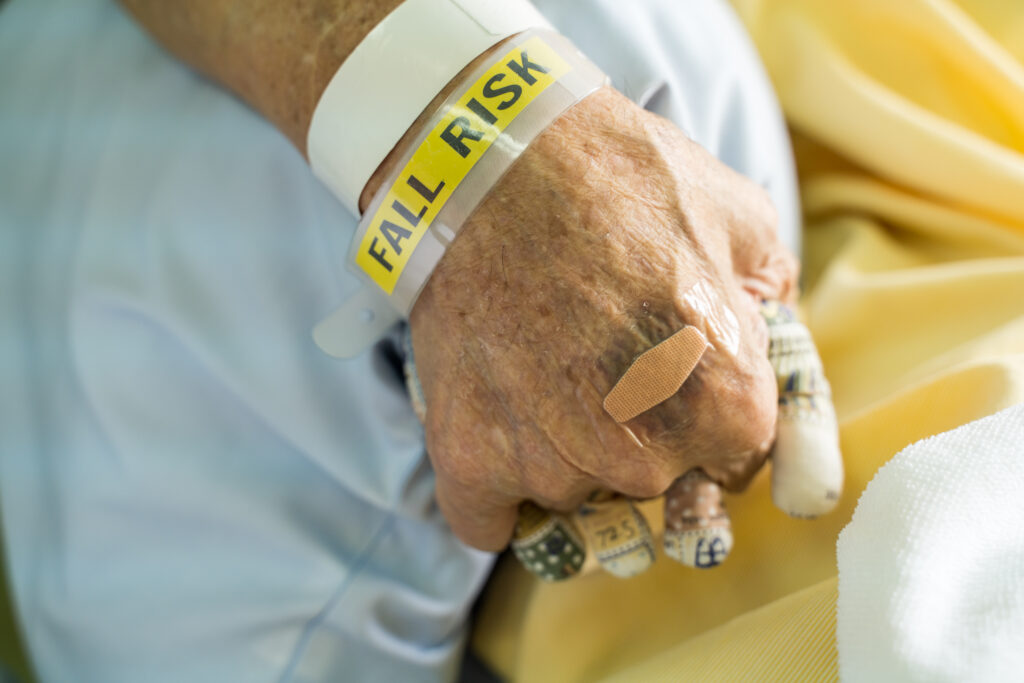
Communication failures. The risk was identified and the interventions were ordered, but the information did not travel with the patient. Risk status is not flagged on the chart, the wristband, or the door. A patient transferred from one unit to another arrives without the receiving team knowing they are a falls risk. A handoff at shift change skips the falls plan. The patient, predictably, falls.
These categories track the claims data published by the Healthcare Insurance Reciprocal of Canada (HIROC), the leading insurer of hospitals in this country.
What does not necessarily mean negligence
It is worth saying plainly: a serious injury from a hospital fall is not, by itself, evidence of negligence. Hospital patients are often elderly, often medicated, often confused, and often unsteady on their feet. Even with careful assessment, well-implemented interventions, and good communication, some patients will still fall. The legal question is whether reasonable care was taken, given what the hospital knew about the patient. That answer lives in the records.
What patients and families should do after a serious fall
If a fall in hospital has caused a serious injury, the most useful early steps are practical, not legal.
Ask whether an incident report was created. Hospitals are required to document falls, and an incident report (sometimes called a critical incident or adverse event report) will usually exist. Patients and substitute decision-makers are generally entitled to know whether one was created and to receive the disclosure that follows from it.
Request the complete medical records. A complete copy of the inpatient chart is usually decisive in these cases. The falls risk assessment, the care plan, the medication administration record, the nursing notes, and the post-fall assessment all live there.
Note the time, location, and circumstances of the fall in your own words while the details are fresh. Who was present, what the patient was doing, where the call bell, mobility aid, and supervision were at the time, and how long the patient was on the floor before being found.
Speak with a lawyer experienced in medical malpractice. Not every fall, even a serious one, will support a claim. A hospital that did everything right may still have a patient fall. A consultation will usually tell you, after a review of the records, whether there is something worth investigating further.
For more on the legal framework, see Suing for Medical Malpractice in Ontario: What You Need to Know. For non-litigation options like complaints to the hospital or to the regulatory colleges, see A Patient’s Guide to Making Complaints About Health Care in Ontario. The broader practice area is covered at Hospital Negligence.
The first conversation is free and strictly confidential. The earlier we look at the records, the better.