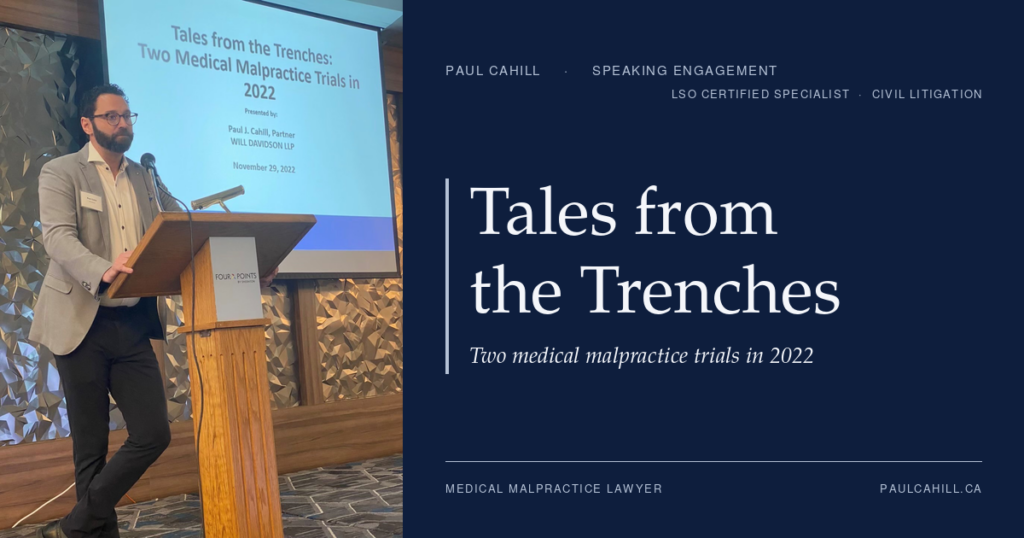
On November 29, 2022, Paul presented at Gluckstein Lawyers’ 4th Annual Medical Malpractice Conference, “Risky Business,” held in Thorold, Ontario. The audience was a mix of personal injury lawyers and law clerks. The topic was two medical malpractice cases that Paul had taken to trial that year, one in front of a jury and one before a judge alone, and the firsthand experience of trying medical malpractice cases in the first full year of post-pandemic court operations.
Retrospective accounts of trial work are how a small specialized bar shares the lessons that only come out of actually being in court. Medical malpractice trials are not common events. Many practitioners in this area go several years between trials. To take two cases to trial in a single year is unusual, and the comparison between a jury trial and a judge-alone trial in the same year, on the same kind of case, produces observations that would otherwise take a decade to assemble.
The post-pandemic context
Civil trials in Ontario were substantially disrupted from March 2020 onward. In-person hearings were suspended, jury trials were paused, and the case backlog accumulated through the first eighteen months of the pandemic. By the time 2022 arrived, the courts were working through a queue of files that had been waiting, in some cases, for years.
That backdrop changed the conditions of trial work in real ways. Witness availability was tighter, because experts who had been booked for adjourned trial dates now had compressed schedules. Documentary evidence handling had partly moved to digital, which carried efficiencies and risks. Court scheduling was less predictable. Settlement discussions carried the additional weight of “we’ve already waited this long,” which could push parties toward resolution but could also push them toward trial after years of preparation.
The two cases Paul tried in 2022 reflected those conditions. The work that went into both of them had been done largely before the pandemic. The trials themselves happened in a court system that was still finding its footing.
Jury versus judge-alone in medical malpractice
In Ontario civil litigation, either party can deliver a jury notice. In medical malpractice files, defence counsel routinely do. The plaintiff can move to strike the jury, but the bar is high, and most medical malpractice cases that go to trial in Ontario are heard by a jury.
Trying the same kind of case to a jury and to a judge alone produces a sharp contrast. The two formats demand different work.
A jury trial requires the medicine to be translated into terms that twelve lay jurors can follow without losing the precision that the expert evidence depends on. Demonstrative aids, plain-language framing, and the order in which witnesses are called all matter more in a jury trial. The defence’s expert evidence carries more rhetorical weight in front of a jury, and cross-examination has to neutralize it on terms the jury can understand. The closing has to give the jury a usable framework for the questions on the verdict sheet.
A judge-alone trial is, by comparison, a more technical exercise. The medicine can be presented at a higher level of detail. The expert evidence is engaged on its own terms. Cross-examination can be more legalistic. The trial judge will provide reasons, which become the focus of the case in a way that a jury’s verdict (which comes with no reasons) does not.
Neither format is inherently better for the plaintiff. The choice between them, where it is available, depends on the facts of the case, the strength of the medical narrative, the credibility of the witnesses, and the local civil trial culture. Where the choice is not available, plaintiff counsel build the case for the format that has been imposed.
What trial work teaches
Most of the work in a medical malpractice file is done in the years before trial. The pleadings, the discoveries, the expert reports, the motions, the mediations, and the pre-trial conferences are where the substantive shape of the case is set. By the time the trial begins, the strategic decisions have largely been made.
Trial itself teaches a narrower set of things. It teaches how to manage real-time evidentiary problems, how to read the room in a courtroom, how to adjust cross-examination as the witness’s answers unfold, and how to maintain the theory of the case when the evidence does not arrive in the order the lawyer expected.
It also calibrates settlement value. A practitioner who has tried cases knows what kinds of cases are worth what at trial, and which kinds of cases settle for less than they would have been worth if they had been pushed. That calibration is hard to acquire in any other way.
Practical observations
For the plaintiff bar in Ontario, opportunities to share experience from medical malpractice trials are limited in number and high in value. Conferences like Gluckstein’s Risky Business event give practitioners a forum to compare the strategic and practical decisions that get made when a file finally reaches a courtroom. The cases themselves cannot be discussed in detail (the privilege concerns and the personal circumstances of the clients make that inappropriate), but the lessons can.
In a year in which two cases reached trial, in different formats, in a court system still adjusting to post-pandemic operations, those lessons were worth the trip to Thorold to share.