Representing Victims of Medical Malpractice Across Ontario

Articles Tagged

Civil Procedure

Civil procedure is the body of rules that governs how a lawsuit is conducted, from the issuance of the claim through pleadings, discovery, motions, pre-trial, and trial. In Ontario, most medical malpractice actions proceed in the Superior Court of Justice under the Rules of Civil Procedure, and procedural decisions often shape the course and cost of a case as much as the substantive law does.

Recurring procedural issues in medical malpractice litigation include the expert evidence requirements of Rule 53.03, the framework for summary judgment refined by the Supreme Court of Canada in Hryniak v Mauldin, 2014 SCC 7, [2014] 1 SCR 87, the scope of documentary and oral discovery, the addition of parties, and the management of the long timelines typical of expert-driven cases. Procedural rulings can determine whether a claim survives to trial at all.

Posts tagged Civil Procedure analyze Ontario decisions on the procedural rules that govern how medical malpractice actions are litigated.

14 articles View all topics →
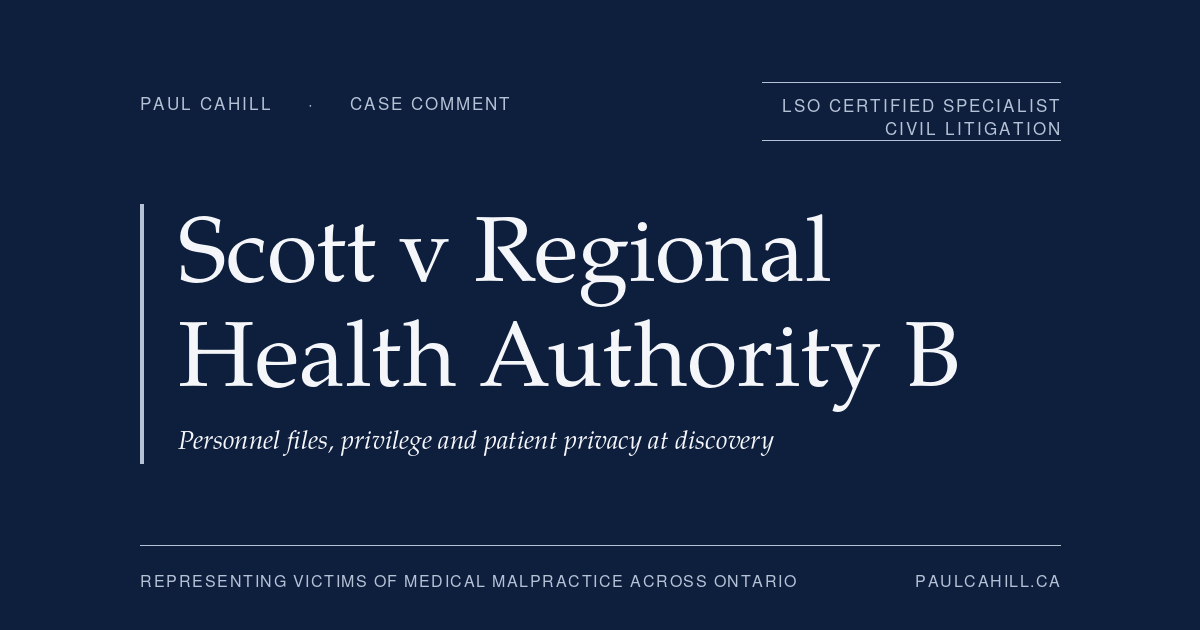
Navy title card reading "Scott v Regional Health Authority B, Personnel files, privilege and patient privacy at discovery" from paulcahill.ca, labelled Case Comment.

Scott v Regional Health Authority B: What a Class Action Discloses at Discovery

In the certified Moncton oxytocin class action, a New Brunswick court has ordered the defendant nurse’s personnel file produced, rejected most of the hospital’s quality-improvement privilege claims, and refused to disclose the private health records of other patients. The disclosure reasoning is persuasive only in Ontario, but it tracks the Ontario approach closely.

Read More »
Have a Case Like This?

Concerned about medical negligence?
Talk to Paul directly.

Free, confidential consultations. Paul reviews every potential case personally and tells you honestly whether it merits investigation.