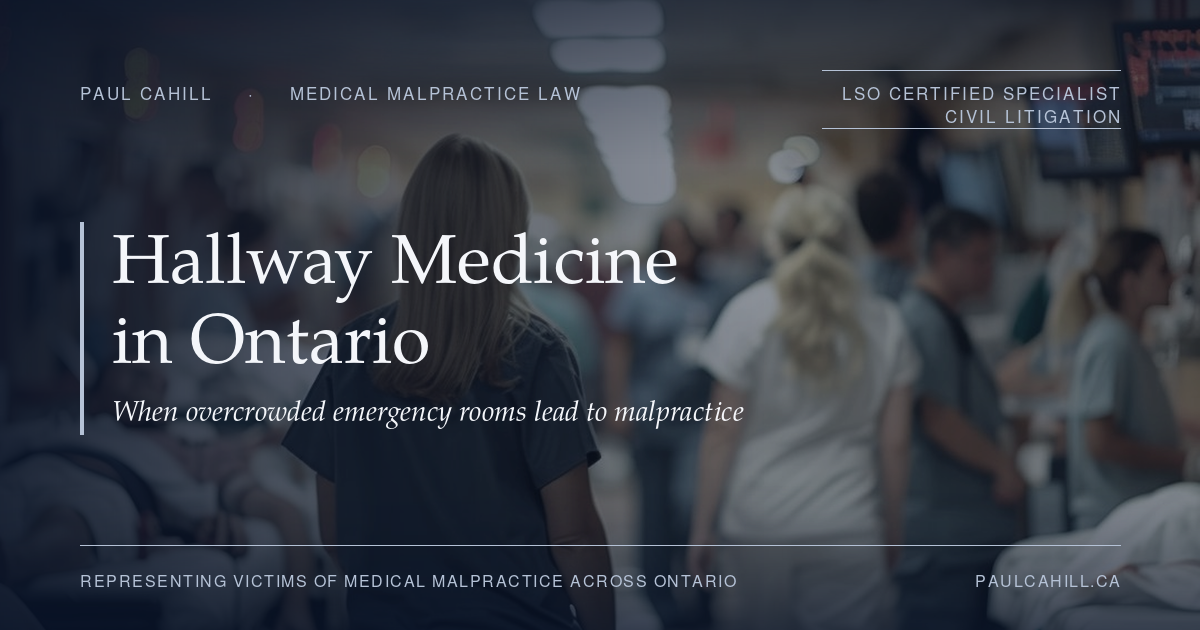
Hallway Medicine in Ontario: When Overcrowded Emergency Rooms Lead to Medical Malpractice
When overcrowded Ontario emergency departments contribute to delayed diagnoses, premature discharges, or death, the legal standard of care does not bend.
Representing Victims of Medical Malpractice Across Ontario
The Canadian Triage and Acuity Scale (CTAS) is the standardized system used in Canadian emergency departments to sort patients by the urgency of their presenting condition, from the most critical to the least. Triage decisions determine how quickly a patient is assessed and treated, and a triage score that understates a patient’s acuity can delay care for a time-sensitive condition.
In emergency medicine litigation, triage features in allegations that a patient was under-triaged and left to wait while a serious condition such as sepsis, stroke, or a cardiac event went unrecognized. Triage is primarily a nursing function, and the standard of care is established through expert evidence calibrated to the role of the triage nurse and to the realities of a busy emergency department, with the scale serving as background rather than as a substitute for the legal standard. Causation links the triage delay to the worsened outcome.
Posts tagged CTAS Triage analyze Ontario decisions involving emergency department triage and the consequences of under-triage.

When overcrowded Ontario emergency departments contribute to delayed diagnoses, premature discharges, or death, the legal standard of care does not bend.

Ontario mid-trial ruling adopts but-for phrasing for jury causation questions in delayed diagnosis aneurysm case but declines to require jurors to give reasons.
Hundreds of thousands of Canadians leave the ER without being seen each year. Here’s how Ontario law treats wait times, harm, and contributory negligence.
Free, confidential consultations. Paul reviews every potential case personally and tells you honestly whether it merits investigation.