
Pellerin v Balfour: Negative Imaging, Differential Diagnosis, and ER Discharge
The BC Supreme Court dismisses a missed-appendicitis claim. Normal ultrasound, documented differential diagnosis, and the anchoring bias allegation rejected.
The BC Supreme Court dismisses a missed-appendicitis claim. Normal ultrasound, documented differential diagnosis, and the anchoring bias allegation rejected.
When a surgical complication is extreme and rare, the trier of fact can infer negligence from the outcome itself. Trial win on shoulder replacement nerve injury.
The Saskatchewan Court of Appeal affirms dismissal of a failure-to-refer claim. Breach of standard of care, but causation defeated by referral wait times.
A settlement on behalf of a 40-year-old woman whose hysterectomy was described as uncomplicated but resulted in injuries to both ureters and chronic disability.

A 17-day birth injury trial. Battery, informed consent, five negligence allegations, and causation all addressed and rejected. A multi-ground defence dismissal.

The Court of Appeal affirmed plaintiff causation in a stroke malpractice case, holding that defendants cannot rely on evidentiary gaps their own negligence created.
A settlement on behalf of a woman in her 60s whose family physician dismissed three years of GI symptoms despite a known family history of colon cancer.
The Court of Appeal affirmed a $12 million plaintiff verdict for catastrophic maternal brain injury, rejecting the defence theory of amniotic fluid embolism.
A failed obstetric epidural with a fractured needle did not prove substandard technique. The British Columbia court rejected outcome-based reasoning on both grounds.
The Court of Appeal affirmed the dismissal of a medical negligence claim alleging failure to report child protection concerns. The causation chain failed at multiple links.
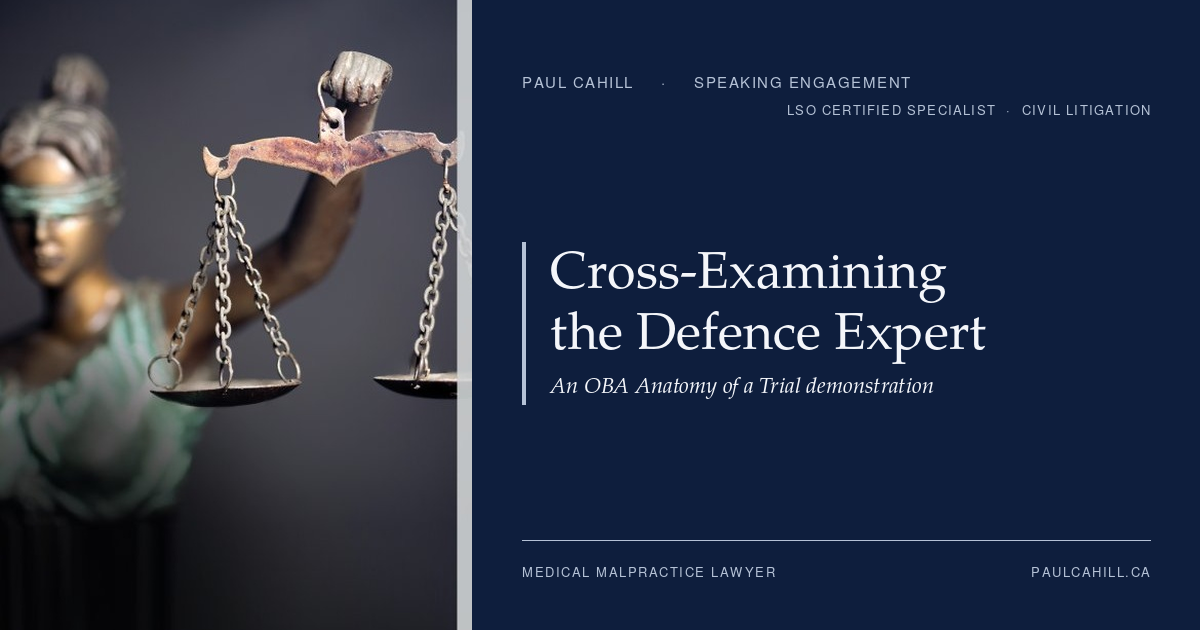
How to cross-examine the defence expert and advance your case theory. From the 2024 OBA Anatomy of a Trial continuing professional development program.
A delayed Lyme disease claim against two Ontario physicians dismissed on multiple grounds, including the most fundamental: the plaintiff failed to prove he had Lyme disease.