A Failure to Admit, an Acute Psychiatric Crisis, and a Catastrophic Injury Settlement
A settlement on behalf of a patient discharged from hospital despite signs of acute psychiatric illness, who suffered catastrophic injury within 24 hours.
A settlement on behalf of a patient discharged from hospital despite signs of acute psychiatric illness, who suffered catastrophic injury within 24 hours.
How plaintiff-side PI practice works as a business: case screening, partnerships, and resourcing. From a 2024 Legal Innovation Forum panel.
A settlement on behalf of a 40-year-old woman whose hysterectomy was described as uncomplicated but resulted in injuries to both ureters and chronic disability.
A settlement on behalf of a woman in her 60s whose family physician dismissed three years of GI symptoms despite a known family history of colon cancer.
When can a defendant compel genetic testing in a medical malpractice claim? An analysis of Klinck v Dorsay and Preece v Nicholson from a 2023 OTLA paper.
A settlement on behalf of the family of a 39-year-old mother of two whose breast cancer was diagnosed too late after a missed opportunity to investigate.
Yes, but the harder question is whether your situation supports a viable claim. An honest threshold assessment for Ontario patients considering legal action.
A medication error caused real distress but no compensable mental injury. The Court of Appeal applied the Saadati threshold and dismissed the claim.
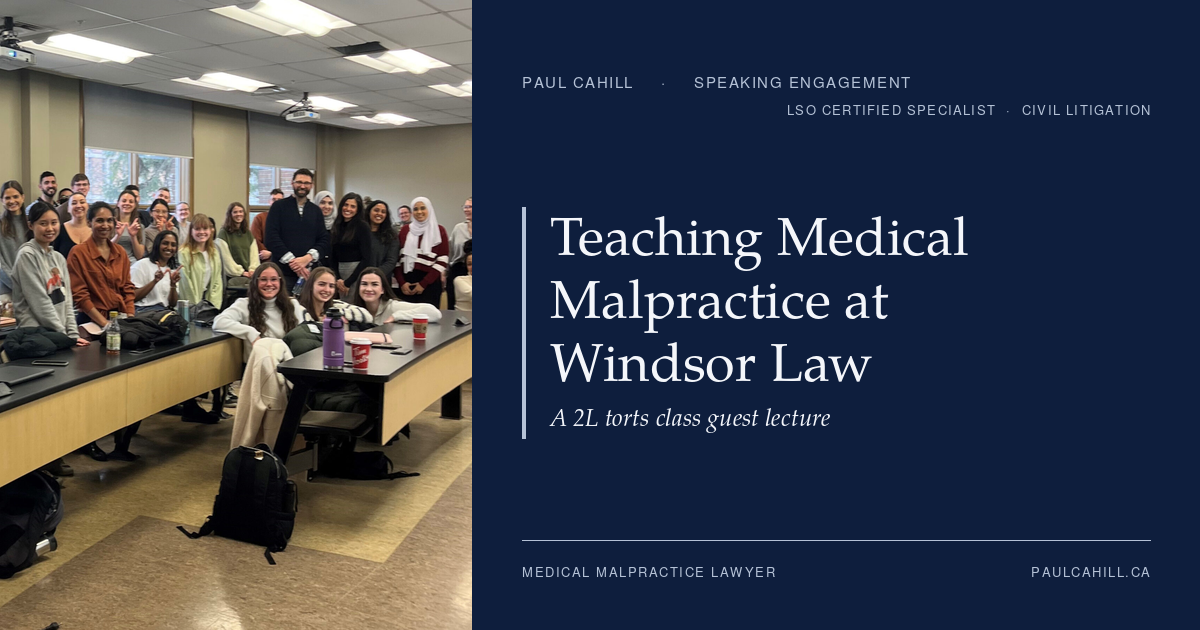
The essential evidence required to prove a medical malpractice claim in Ontario. From a 2023 guest lecture at the University of Windsor Faculty of Law.
A settlement involving a 65-year-old man whose ankle fracture went 40 days without orthopedic follow-up, leading to joint infection and below-knee amputation.
Why screening medical malpractice cases matters at intake, and what to recommend patients when civil litigation is not economical. From a 2021 CLE panel.
Paul Cahill won a trial verdict in Hacopian-Armen v Mahmoud where Justice Brown found a gynecologist negligently failed to biopsy and missed a curable cancer.