Screening New Medical Malpractice Cases: When to Take Them and When to Pass
Why screening medical malpractice cases matters at intake, and what to recommend patients when civil litigation is not economical. From a 2021 CLE panel.
Why screening medical malpractice cases matters at intake, and what to recommend patients when civil litigation is not economical. From a 2021 CLE panel.
The Ontario Court of Appeal upheld Paul Cahill’s trial verdict in Hacopian-Armen Estate v Mahmoud, clarifying the foreseeability test in delayed cancer cases.
How Ontario judges gatekeep expert opinion evidence, and what plaintiff counsel can do to clear that bar. From a 2021 MLST panel.
Three episodes on the Inside Medical Malpractice podcast with Chris Rokosh. Paul on the trials of Hacopian, O’Neill-Renouf, and Woods v Jackiewicz.
Paul Cahill on Girao v Cunningham, s. 52 of the Evidence Act, and trial fairness for self-represented litigants. From a May 2020 Law Times feature.
Expert evidence, defence resourcing, and high-risk ER scenarios shape Ontario medical malpractice cases. From OTLA’s 2020 medical malpractice conference.
Paul Cahill won a trial verdict in O’Neill-Renouf v Ibrahim where Justice Baltman found a urologist negligently injured the obturator nerve during a TVT procedure.
Why expert selection drives outcomes in Ontario medical malpractice cases. Paul Cahill on finding the right expert from an OTLA webinar.
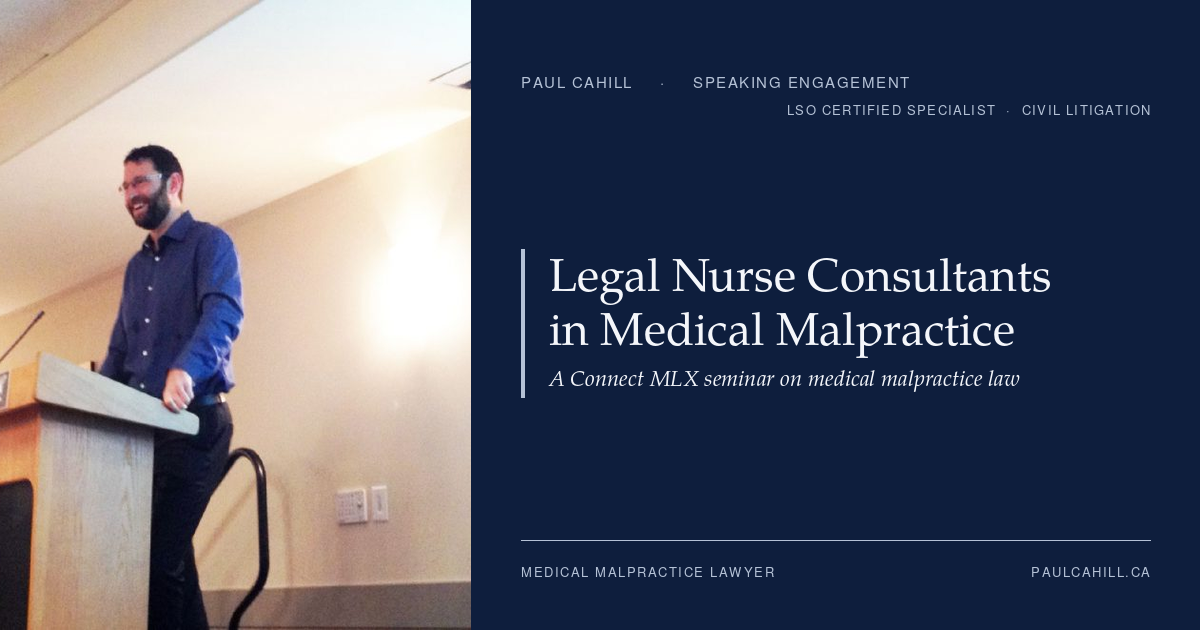
The role of legal nurse consultants in medical malpractice cases, from records review to expert identification. From a 2015 Connect MLX seminar.
Paul Cahill’s trial victory in Ayana v Skin Klinic, 2009, established the standard of care for laser hair removal performed in an Ontario dermatology clinic.