Sutherland v Booth: A Tragic Stroke Case Defeated on the Expert Evidence
A 27-year-old woman died from a missed cerebellar stroke after an ER discharge. The malpractice claim was dismissed when the plaintiff’s expert evidence unravelled at trial.
A 27-year-old woman died from a missed cerebellar stroke after an ER discharge. The malpractice claim was dismissed when the plaintiff’s expert evidence unravelled at trial.
Three 2023 decisions from Alberta, Ontario, and Newfoundland show why self-represented plaintiffs almost never succeed in medical malpractice litigation.
When can a defendant compel genetic testing in a medical malpractice claim? An analysis of Klinck v Dorsay and Preece v Nicholson from a 2023 OTLA paper.
September 2023 coverage in CP24 and the Brampton Guardian of the Thompson v Handler trial decision finding an ER physician negligent for the death of a 34-year-old mother.
A self-represented plaintiff’s Lyme disease delayed-diagnosis claim was dismissed at summary judgment after his sole expert witness was disqualified.
A negligent stroke discharge that failed at causation. The Ontario Court of Appeal upheld the dismissal of the action, despite an admitted breach of standard of care.
A Manitoba decision in which a physician was found negligent without expert evidence, illustrating the narrow common-sense exception under ter Neuzen v Korn.
A plaintiffs’ motion to pierce litigation privilege over expert communications fails despite real credibility concerns about a defendant doctor’s evidence.
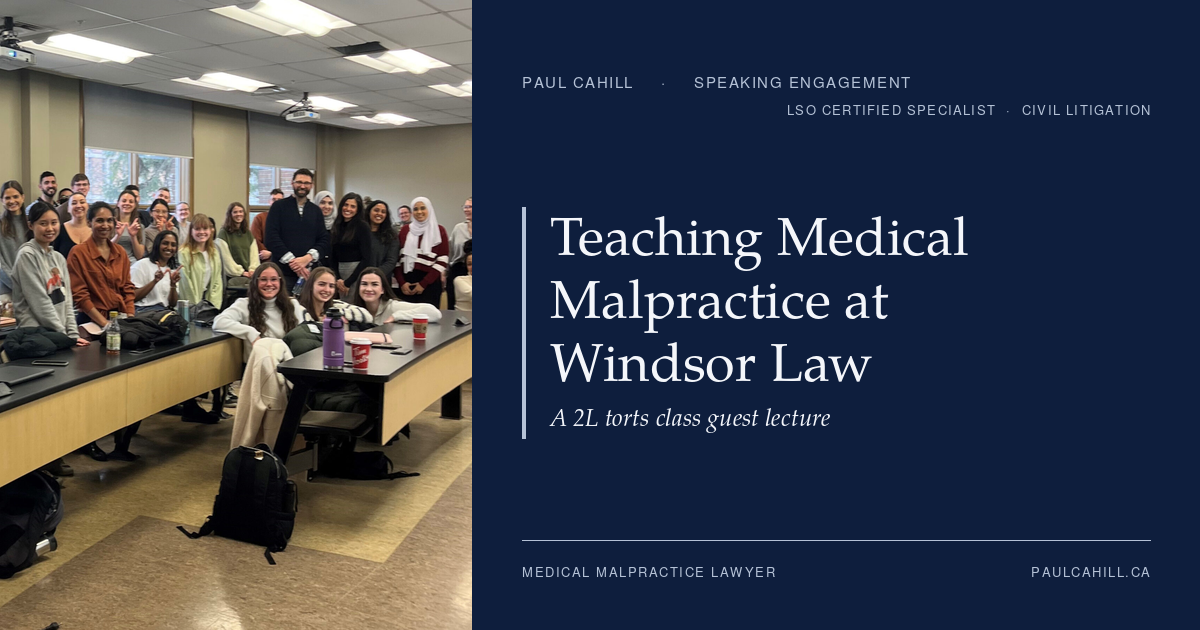
The essential evidence required to prove a medical malpractice claim in Ontario. From a 2023 guest lecture at the University of Windsor Faculty of Law.
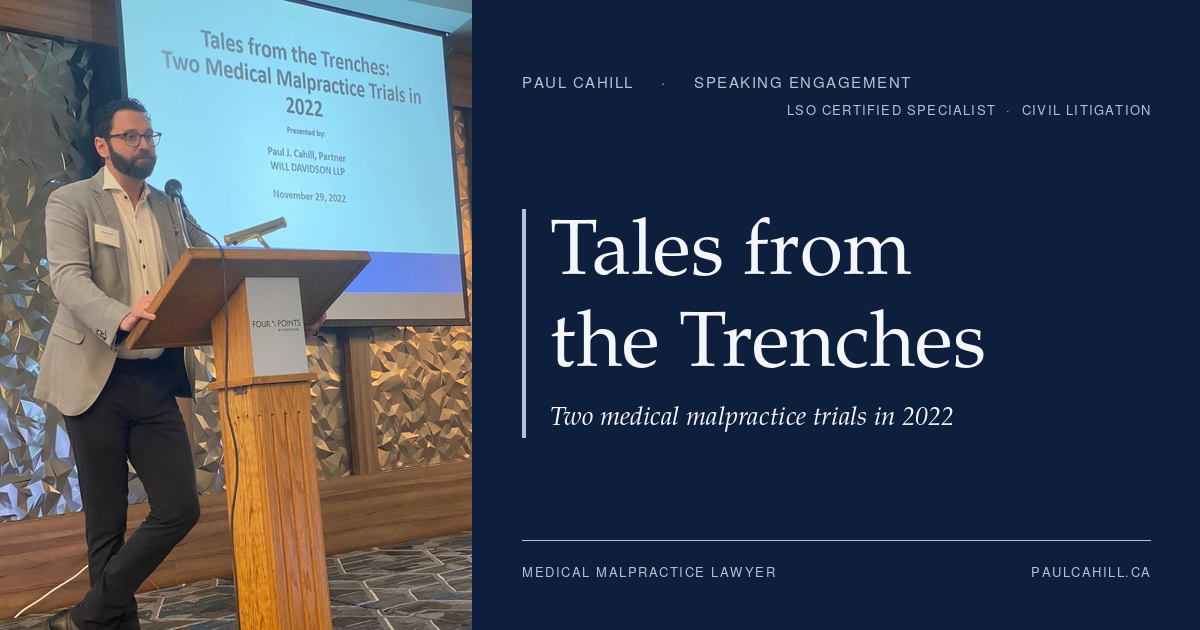
Reflections on two medical malpractice trials in post-COVID Ontario, one jury and one judge-alone. From Gluckstein’s 2022 Risky Business CLE.

Where literature, medicine, and the law intersect at a medical malpractice trial in Ontario. From a 2022 OTLA medical malpractice conference panel.
Paul as guest on Justice in Pieces, the legal education YouTube series with John-Paul Rodrigues. On the realities of plaintiff-side medical malpractice practice.