Causation: Medical Malpractice and Intervening Acts at the LSO Motor Vehicle Litigation Summit
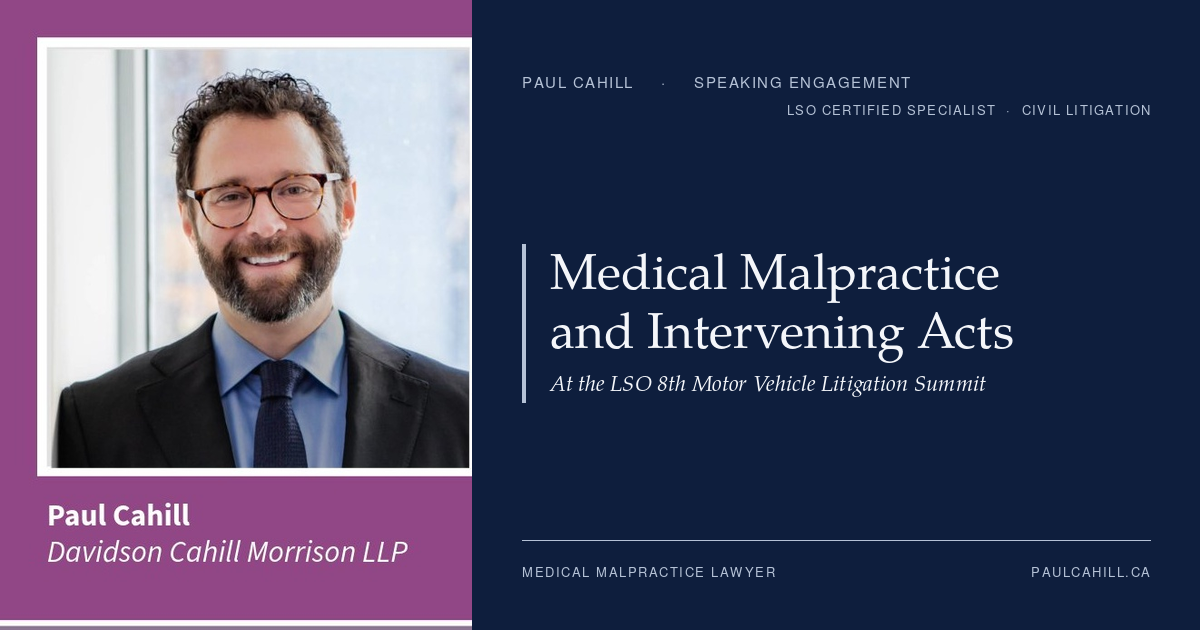
Medical malpractice as an intervening act in MVA cases. A Baines v Abounaja analysis from Paul’s 2025 LSO Motor Vehicle Litigation Summit presentation.
Representing Victims of Medical Malpractice Across Ontario
Causation is the second element a plaintiff must prove in an Ontario medical malpractice claim, after standard of care and before damages. The plaintiff must show that the defendant’s negligence caused the injury, ordinarily by satisfying the “but for” test: but for the negligent act or omission, the injury would not have occurred. The Supreme Court of Canada confirmed this approach in Clements v Clements, 2012 SCC 32, [2012] 2 SCR 181, while recognizing a limited “material contribution to risk” exception in narrow circumstances.
In medical cases, causation is often the most contested element. A plaintiff who proves a clear breach of the standard of care may still lose at trial if expert evidence cannot bridge the gap between the breach and the injury. Lost-chance arguments, delayed-diagnosis fact patterns, and cases involving multiple potential causes raise some of the hardest causation questions in Canadian tort law.
Posts tagged Causation analyze how Ontario courts have approached these issues across obstetrical, oncology, emergency, and surgical fact patterns, including appellate decisions that shape how trial judges instruct themselves on the test.

Medical malpractice as an intervening act in MVA cases. A Baines v Abounaja analysis from Paul’s 2025 LSO Motor Vehicle Litigation Summit presentation.

A settlement on behalf of a patient diagnosed with terminal metastatic cancer based on imaging alone, who lived for an extended period under a wrong diagnosis.

Ontario mid-trial ruling adopts but-for phrasing for jury causation questions in delayed diagnosis aneurysm case but declines to require jurors to give reasons.

New Brunswick court holds anesthesiologist negligent in death of 36-year-old patient with severe obesity and sepsis after spinal anesthesia choice and management.

Manitoba Court of Appeal affirms dismissal of delayed colon cancer diagnosis claim. The Benhaim framework on adverse inferences and statistical evidence in causation.

Ontario Superior Court dismisses fatal aortic dissection claim against internist and ED physician. The standards of care for mild aortic dilation and hypertensive chest pain.

Ontario Superior Court finds gynecologic surgeon liable for unrecognized intraoperative bowel injury. The duty to inspect framework in laparoscopic surgery.

A settlement on behalf of a patient discharged from hospital despite signs of acute psychiatric illness, who suffered catastrophic injury within 24 hours.

Ontario Superior Court dismisses post-operative osteomyelitis claim. The hospitalist standard of care, patient-declined treatment, and the pre-existing infection defence.

Ontario Superior Court finds pediatric neurologists negligent for delayed pyridoxine treatment in PDE. The low-risk alternative framework and twin sister causation.

Alberta King’s Bench dismisses critical care malpractice claim. Standard of care breached on echocardiography timing, but causation defeated by temporal mismatch.

The Saskatchewan Court of Appeal affirms dismissal of a failure-to-refer claim. Breach of standard of care, but causation defeated by referral wait times.
Free, confidential consultations. Paul reviews every potential case personally and tells you honestly whether it merits investigation.