Thompson v Handler Trial Decision: Coverage in CP24 and the Brampton Guardian
September 2023 coverage in CP24 and the Brampton Guardian of the Thompson v Handler trial decision finding an ER physician negligent for the death of a 34-year-old mother.
September 2023 coverage in CP24 and the Brampton Guardian of the Thompson v Handler trial decision finding an ER physician negligent for the death of a 34-year-old mother.
A delayed-diagnosis cancer claim was dismissed at standard of care and causation, with a 40% contributory negligence finding for repeated failures to follow up.
Roughly 9% of strokes are initially misdiagnosed in the emergency setting. A practical guide to how stroke claims are investigated and proven in Ontario.
A trial judge dismissed a medical malpractice claim against two ER physicians, finding the standard of care was met and that earlier testing would not have changed the outcome.
A patient’s guide to medication errors in Ontario, including the common error patterns, the high-alert drugs, and what it takes to prove a malpractice claim.
A delayed cancer diagnosis can be the difference between life and death. A patient’s guide to the common causes and what it takes to prove a claim in Ontario.
Yes, but the harder question is whether your situation supports a viable claim. An honest threshold assessment for Ontario patients considering legal action.
A negligent stroke discharge that failed at causation. The Ontario Court of Appeal upheld the dismissal of the action, despite an admitted breach of standard of care.
I represented the plaintiff in this surgical malpractice case. The trial judge found a breach of the standard of care, but the claim failed at causation.
The Court of Appeal upholds the use of epidemiological evidence to infer causation across a class of patients harmed by a physician’s IPAC failures.
A missed diagnosis of compartment syndrome cost a patient her leg. The trial judge found the ER physician breached the standard of care.
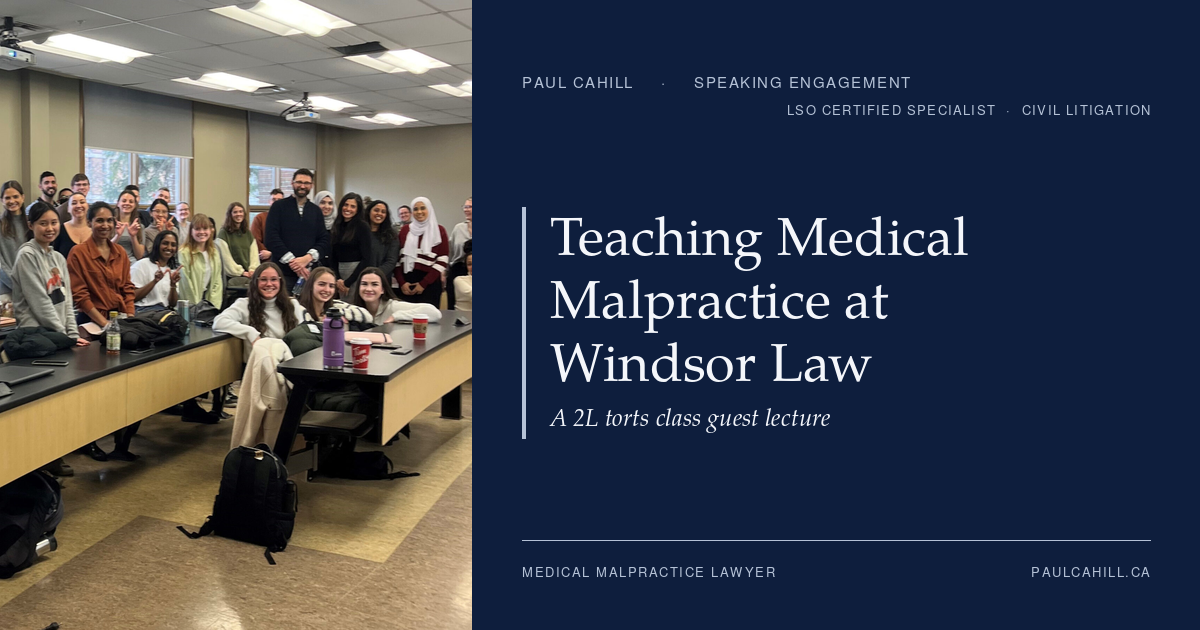
The essential evidence required to prove a medical malpractice claim in Ontario. From a 2023 guest lecture at the University of Windsor Faculty of Law.