A Young Mother of Two, a Delayed Breast Cancer Diagnosis, and a Wrongful Death Settlement
A settlement on behalf of the family of a 39-year-old mother of two whose breast cancer was diagnosed too late after a missed opportunity to investigate.
A settlement on behalf of the family of a 39-year-old mother of two whose breast cancer was diagnosed too late after a missed opportunity to investigate.
The Court of Appeal upholds the use of epidemiological evidence to infer causation across a class of patients harmed by a physician’s IPAC failures.
The College of Physicians and Surgeons of Ontario (“CPSO”) regulates the practice of medicine in Ontario. Physicians are required to be members of the CPSO to practice medicine. The role of the CPSO, its authority and powers are set out in the Regulated Health Professions Act (“RHPA”), the Health Professions Procedural Code under the RHPA and the Medicine Act.
A missed diagnosis of compartment syndrome cost a patient her leg. The trial judge found the ER physician breached the standard of care.
A plaintiffs’ motion to pierce litigation privilege over expert communications fails despite real credibility concerns about a defendant doctor’s evidence.
Most bad outcomes in medicine are not malpractice. After two decades of these cases in Ontario, here are the signs worth taking seriously.
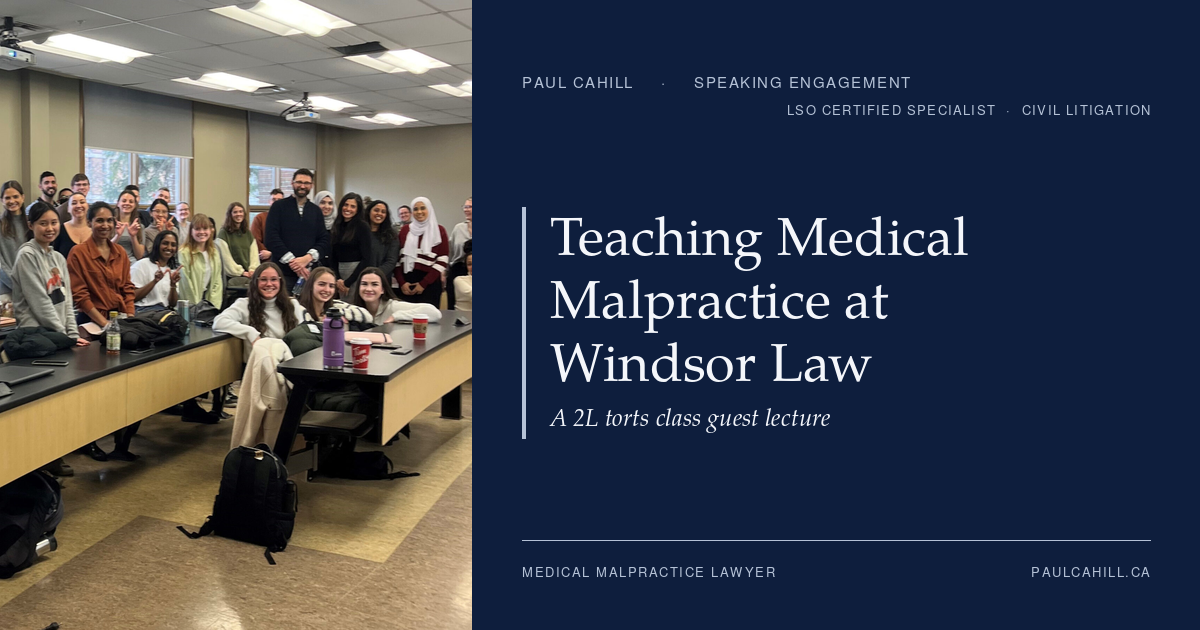
The essential evidence required to prove a medical malpractice claim in Ontario. From a 2023 guest lecture at the University of Windsor Faculty of Law.
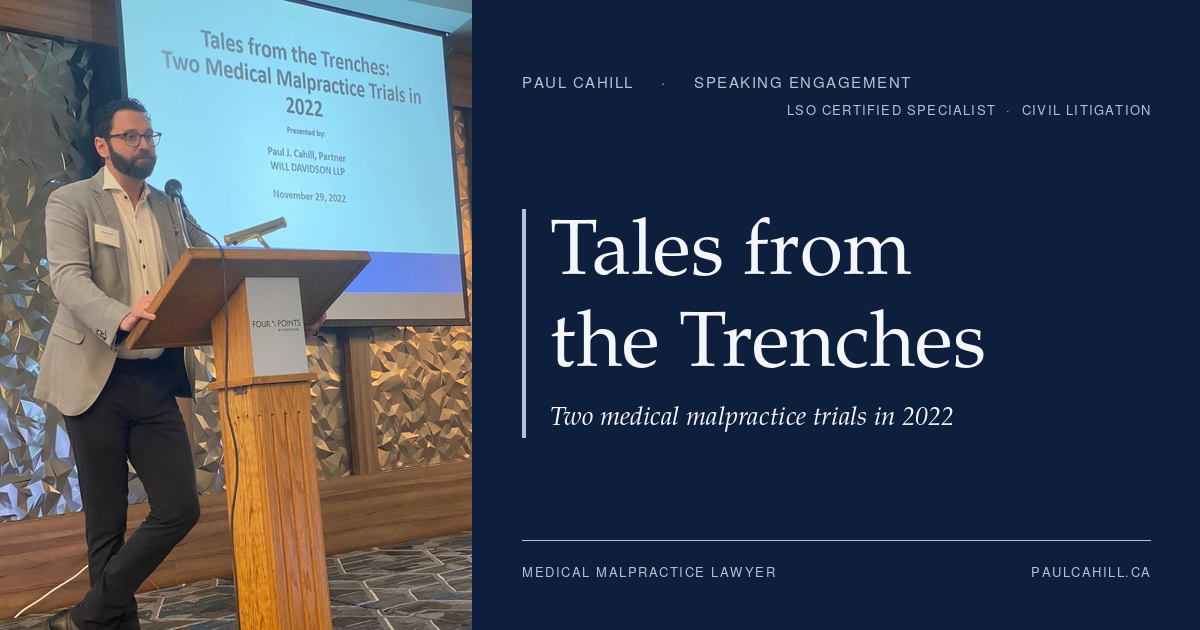
Reflections on two medical malpractice trials in post-COVID Ontario, one jury and one judge-alone. From Gluckstein’s 2022 Risky Business CLE.
On Inside Medical Malpractice with Chris Rokosh: medication errors as Never Events, the 10 rights of medication administration, and what they mean in litigation.
A settlement involving a 65-year-old man whose ankle fracture went 40 days without orthopedic follow-up, leading to joint infection and below-knee amputation.
Where literature, medicine, and the law intersect at a medical malpractice trial in Ontario. From a 2022 OTLA medical malpractice conference panel.
Paul as guest on Justice in Pieces, the legal education YouTube series with John-Paul Rodrigues. On the realities of plaintiff-side medical malpractice practice.